Our mission is to help computational modelers develop, document, and share their computational models in accordance with community standards and good open science and software engineering practices. Model authors can publish their model source code in the Computational Model Library with narrative documentation as well as metadata that supports open science and emerging norms that facilitate software citation, computational reproducibility / frictionless reuse, and interoperability. Model authors can also request private peer review of their computational models. Models that pass peer review receive a DOI once published.
All users of models published in the library must cite model authors when they use and benefit from their code.
Please check out our model publishing tutorial and feel free to contact us if you have any questions or concerns about publishing your model(s) in the Computational Model Library.
Displaying 10 of 215 results for "Friederike Lenel" clear search
We propose here a computational model of school segregation that is aligned with a corresponding Schelling-type model of residential segregation. To adapt the model for application to school segregation, we move beyond previous work by combining two preference arguments in modeling parents’ school choice, preferences for the ethnic composition of a school and preferences for minimizing the travelling distance to the school.
Population aggregation in ancient arid environments
Marco Janssen | Published Tuesday, May 04, 2010 | Last modified Saturday, April 27, 2013The purpose of this model is to help understand how prehistoric societies adapted to the prehistoric American southwest landscape. In the American southwest there is a high degree of environmental var
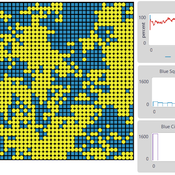
The current model is designed to examine whether—and under what conditions—minority influence can generate social change. Specifically, the model assesses whether empirically validated psychological mechanisms of indirect minority influence, operating in combination, can produce system-level social change, defined as the initial minority opinion becoming the majority position. Notably, this model formalizes Moscovici’s (1976) genetic model of social influence using agent-based modeling.
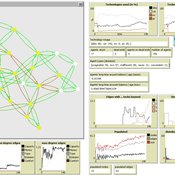
Simulation of the Governance of Complex Systems
Fabian Adelt Johannes Weyer Robin D Fink Andreas Ihrig | Published Monday, December 18, 2017 | Last modified Friday, March 02, 2018Simulation-Framework to study the governance of complex, network-like sociotechnical systems by means of ABM. Agents’ behaviour is based on a sociological model of action. A set of basic governance mechanisms helps to conduct first experiments.
Activation and Foreclosure: An Agent-Based Model of Enforcement and Exit in Codified Moral Communities
Kiran Boggavarapu | Published Wednesday, August 19, 2026An agent-based model of rule-governed (religious) communities in which networked agents observe one another’s conduct, sanction deviation,
and decide whether to remain. The model separates two structural conditions for durable capture. First, whether an enforcement apparatus
activates: agents punish deviation only where conduct is observable (the code-geometry parameter sigma) and where sanctioning is
institutionally rewarded (pi), a joint threshold in which neither condition alone suffices. Second, whether members’ exit is foreclosed: an
outside-option degradation (delta) that can be imposed exogenously or allowed to drift with enforcement activity. Punishment concentrates in
a small, endogenously recomputed enforcer cadre, but that concentration is produced by an institutional privilege bundle (a punishment
…
Relational integration in schools through seating assignments
Károly Takács Marta Rado | Published Thursday, July 18, 2019We model interpersonal dynamics and study behavior in the classroom in the hypothetical case of a single teacher who defines students’ seating arrangements. The model incorporates the mechanisms of peer influence on study behavior, on attitude formation, and homophilous selection in order to depict the interrelated dynamics of networks, behavior, and attitudes. We compare various seating arrangement scenarios and observe how GPA distribution and level of prejudice changes over time.
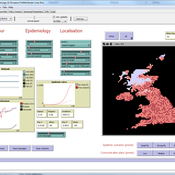
TELL ME: protective behaviour in an epidemic
Jennifer Badham | Published Tuesday, February 10, 2015Models the connection between health agency communication, personal protective behaviour (eg vaccination, hand hygiene) and influenza transmission.
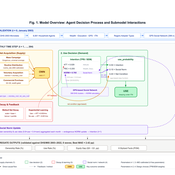
Peer reviewed Kenya ITN Agent-Based Microsimulation (2003–2024)
Wooyoung Kim Hosang Shin | Published Saturday, April 18, 2026 | Last modified Tuesday, June 16, 2026An agent-based microsimulation of insecticide-treated net (ITN) distribution and adoption in Kenya (2003–2024), integrating the Theory of Planned Behaviour, Rogers diffusion, Weibull net decay, and a GPS-based two-layer social network. 8,561 household agents calibrated via Approximate Bayesian Computation to six DHS/MIS survey waves, achieving 2.42 pp mean absolute error on Kenya-level ownership. The analysis chain supports mechanism counterfactuals and policy experiments on equity outcomes of ITN distribution strategies.
Asymmetric two-sided matching
Naoki Shiba | Published Wednesday, January 09, 2013 | Last modified Tuesday, May 28, 2013This model is an extended version of the matching problem including the mate search problem, which is the generalization of a traditional optimization problem. The matching problem is extended to a form of asymmetric two-sided matching problem.
Coastal Coupled Housing and Land Markets (C-CHALMS)
Nicholas Magliocca | Published Thursday, May 18, 2017Next generation of the CHALMS model applied to a coastal setting to investigate the effects of subjective risk perception and salience decision-making on adaptive behavior by residents.
Displaying 10 of 215 results for "Friederike Lenel" clear search