Our mission is to help computational modelers develop, document, and share their computational models in accordance with community standards and good open science and software engineering practices. Model authors can publish their model source code in the Computational Model Library with narrative documentation as well as metadata that supports open science and emerging norms that facilitate software citation, computational reproducibility / frictionless reuse, and interoperability. Model authors can also request private peer review of their computational models. Models that pass peer review receive a DOI once published.
All users of models published in the library must cite model authors when they use and benefit from their code.
Please check out our model publishing tutorial and feel free to contact us if you have any questions or concerns about publishing your model(s) in the Computational Model Library.
Displaying 10 of 1163 results for "Bin-Tzong Chi" clear search
Schelling Model of the City of Salzburg
Andreas Schlagbauer | Published Monday, December 05, 2022The purpose of the model is to better understand, how different factors for human residential choices affect the city’s segregation pattern. Therefore, a Schelling (1971) model was extended to include ethnicity, income, and affordability and applied to the city of Salzburg. So far, only a few studies have tried to explore the effect of multiple factors on the residential pattern (Sahasranaman & Jensen, 2016, 2018; Yin, 2009). Thereby, models using multiple factors can produce more realistic results (Benenson et al., 2002). This model and the corresponding thesis aim to fill that gap.
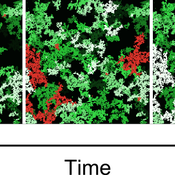
Feedback Loop Example: Wildland Fire Spread
James Millington | Published Friday, December 21, 2012 | Last modified Saturday, April 27, 2013This model is a replication of that described by Peterson (2002) and illustrates the ‘spread’ feedback loop type described in Millington (2013).
cultural group and persistent parochialism
Jae-Woo Kim | Published Monday, November 08, 2010 | Last modified Saturday, April 27, 2013Discriminators who have limited tolerance for helping dissimilar others are necessary for the evolution of costly cooperation in a one-shot Prisoner’s Dilemma. Existing research reports that trust in
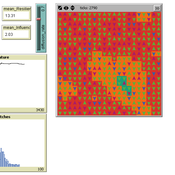
SpeciesWorld
Tony Lawson | Published Friday, March 16, 2012 | Last modified Saturday, April 27, 2013How can species evolve a cooperative network to keep the environment suitable for life?
From Cyber Space Opinion Leaders and the Spread of Anti-Vaccine Extremism to Physical Space Disease Outbreaks
Xiaoyi Yuan | Published Wednesday, March 08, 2017 | Last modified Friday, March 31, 2017This model simulates the spread of anti-vaccine sentiments in cyber and physical space and how it creates emergence of clusters of anti-vacciners, which eventually lead to higher probablity of disease outbreaks.
This paper presents an agent-based model to study the dynamics of city-state systems in a constrained environment with limited space and resources. The model comprises three types of agents: city-states, villages, and battalions, where city-states, the primary decision-makers, can build villages for food production and recruit battalions for defense and aggression. In this setting, simulation results, generated through a multi-parameter grid sampling, suggest that risk-seeking strategies are more effective in high-cost scenarios, provided that the production rate is sufficiently high. Also, the model highlights the role of output productivity in defining which strategic preferences are successful in a long-term scenario, with higher outputs supporting more aggressive expansion and military actions, while resource limitations compel more conservative strategies focused on survival and resource conservation. Finally, the results suggest the existence of a non-linear effect of diminishing returns in strategic investments on successful strategies, emphasizing the need for careful resource allocation in a competitive environment.
The code shared here accompanies the paper at https://doi.org/10.1371/journal.pone.0208451. It simulates the effects of various economic trade scenarios on the phenomenon of the ‘disappearing middle’ in the Scottish beef and dairy farming industries. The ‘disappearing middle’ is a situation in which there is a simultaneous observed decline in medium-sized enterprises and rise in the number of small and large-scale enterprises.
CA_Assiut_v1.0
Nina Schwarz Yang Chen m-m-abdelkader Mahmood Abdelkader | Published Sunday, October 09, 2022The purpose of the model is to simulate the future growth of human settlements in the Nile river valley in Egypt. The model contains processes to mimic spatial patterns found in the case study region.
ACT: Agent-based model of Critical Transitions
Igor Nikolic Oscar Kraan Steven Dalderop Gert Jan Kramer | Published Wednesday, October 18, 2017 | Last modified Monday, August 27, 2018ACT is an ABM based on an existing conceptualisation of the concept of critical transitions applied to the energy transition. With the model we departed from the mean-field approach simulated relevant actor behaviour in the energy transition.
Peer reviewed Horse population dynamics
Nika Galic | Published Tuesday, November 12, 2013 | Last modified Wednesday, October 29, 2014This model investigates the link between prescribed growth in body size, population dynamics and density dependence through population feedback on available resources.
Displaying 10 of 1163 results for "Bin-Tzong Chi" clear search