Our mission is to help computational modelers develop, document, and share their computational models in accordance with community standards and good open science and software engineering practices. Model authors can publish their model source code in the Computational Model Library with narrative documentation as well as metadata that supports open science and emerging norms that facilitate software citation, computational reproducibility / frictionless reuse, and interoperability. Model authors can also request private peer review of their computational models. Models that pass peer review receive a DOI once published.
All users of models published in the library must cite model authors when they use and benefit from their code.
Please check out our model publishing tutorial and feel free to contact us if you have any questions or concerns about publishing your model(s) in the Computational Model Library.
Displaying 10 of 1258 results for "Ian M Hamilton" clear search
Status hierarchies and the emergence of cooperation in task groups
Hsuan-Wei Lee | Published Thursday, January 02, 2025This repository contains an agent-based simulation model exploring how status hierarchies influence the emergence and sustainability of cooperation in task-oriented groups. The model builds on evolutionary game theory to examine the dynamics of cooperation under single-leader and multi-leader hierarchies, investigating factors such as group size, assortativity, and hierarchical clarity. Key findings highlight the trade-offs between different leadership structures in fostering group cooperation and reveal the conditions under which cooperation is most stable.
The repository includes code for simulations, numerical analysis scripts, and visualization tools to replicate the results presented in the manuscript titled “Status hierarchies and the emergence of cooperation in task groups.”
Feel free to explore, reproduce the findings, or adapt the model for further research!
Exploring the aftermath of transition failures: An agent-based model
Gangmin Park Junmin Lee Jisoo Lee Keungoui Kim | Published Friday, March 06, 2026This computational model is an agent-based model (ABM) developed to investigate how repeated failures of emerging niches accumulate and influence the trajectory of socio-technical transitions. Built in AnyLogic 8.7.11, the model simulates the dynamic interactions between a dominant regime and sequential niche entrants within a two-dimensional practice space. It models alignment, movement, and competition based on technological maturity and market penetration. The model utilizes a reinforcing feedback structure linking consumer support, output, resource accumulation, and capacity development (Physical and Institutional Capacity). A complete model specification following the ODD+D (Overview, Design concepts, Details, and Decision) protocol is included in the documentation.
NetLogo Model of Spatial Eviction in Attraction-Repulsion Opinion Dynamics
poyeker | Published Friday, March 13, 2026A reproducible NetLogo implementation of a spatial attraction-repulsion opinion model with eviction-driven relocation. Agents interact locally, converge with similar neighbors, diverge from dissimilar neighbors, and may evict the most dissimilar neighbor to a random empty location. Parameter sweeps reveal transitions among extremist, mixed, and consensus regimes, with outputs including phase diagrams, opinion distributions, and Moran’s I. The model is intended to reproduce and extend results on how exclusion frequency changes polarization outcomes.
An Agent-based Model of the Tragedy of the Commons
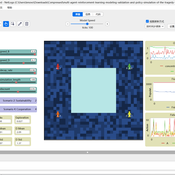
tao liu | Published Sunday, April 12, 2026This is a model that explores how a few fishermen sharing a common fishery learn their harvesting strategies under different incentive settings, and how individual greed, cooperation, and sustainability penalties shape resource depletion and the tragedy of the commons.
Asymmetric Demographic Hysteresis in a Spatial Agent-Based Urban System
Chen Shen | Published Friday, July 24, 2026This paper develops a spatial agent-based model to examine how fertility regime shifts reshape population concentration and wealth distribution in an abstract urban system. Migration decisions combine population preference, cultural homophily, expected net income, and resource endowment through a standardised softmax utility. The design is deliberately stylised: it is not calibrated to a particular country or city system, but is intended to isolate the feedbacks linking migration, fertility, urban scaling, and accumulated wealth.
The simulations reveal robust directional asymmetry. When fertility shifts from low to high, population concentration responds rapidly; when fertility shifts from high to low, concentration declines only after a detectable delay and may temporarily continue in the previous direction. Wealth adds a second layer of hysteresis: cell total-wealth concentration follows population concentration with delay, cell mean-wealth inequality and system-level wealth indicators are slower still, and phase-space trajectories form loops rather than collapsing onto a single population–wealth curve. Robustness experiments indicate that longer fertility cycles, wider mobility neighbourhoods, and smoother resource landscapes change the magnitude of delay and overshoot, but do not remove the qualitative asymmetry. The paper argues that demographic decline should be understood not as the mirror image of demographic expansion, but as a path-dependent transition mediated by fast migration-income feedbacks and slower fertility, cohort, culture, and wealth mechanisms.
Structural Luck: An Agent-Based Model of Workplace Career Dynamics
Yang Ou | Published Sunday, August 23, 2026Why do career outcomes in organizations follow highly skewed distributions when the individual traits presumed to drive success — competence, effort, and social skill — are approximately normally distributed in the population? This agent-based model investigates the relative contributions of individual attributes versus random events (“luck”) to career outcomes in hierarchically structured organizations.
The model places 500 agents in a five-level pyramid-shaped organization over 80 six-month evaluation periods (40 simulated years). Each agent is characterized by four attributes drawn from normal distributions at initialization: competence, effort, social skill, and adaptability. In each period, agents may encounter stochastic career events (good or bad projects, supportive or poor managers, market booms or busts), which modify their performance and visibility scores. Promotion decisions are made competitively when vacancies arise at higher levels, using a weighted combination of recent performance, accumulated visibility, network position, and tenure. Social connections form and decay through a proximity-based model influenced by agents’ social skills.
The model extends the talent-versus-luck framework of Pluchino et al. (2018) in four substantive directions: (1) it embeds agents in a hierarchical organization with finite positions at each level, making promotion a zero-sum competition rather than an abstract encounter with random events; (2) it represents individual differences along four independent attribute dimensions rather than a single talent score; (3) it incorporates dynamic social network formation that mediates access to career-relevant opportunities; and (4) it implements the Peter Principle mechanism through which promoted agents must acquire competence appropriate to their new role.
…
Mobility Sharing for Social Integration: A Reverse Schelling Model
Hongmou Zhang | Published Thursday, October 15, 2026This model extends Schelling’s segregation model with mobility sharing. Agents of two groups occupy cells of a 32 × 32 grid and repeatedly choose activity destinations subject to a preference threshold, the minimum share of ingroup neighbours they accept. Trips are matched into shared rides between members of different groups, using one of four matching algorithms on a shareability network (maximal cross-group matching, maximum weight matching on contact time, maximum cardinality matching, or random greedy matching) with a maximum detour constraint. After each trip, an agent’s preference threshold changes with the time spent in contact with outgroup members.
Starting from complete segregation, the model examines under which conditions contact during shared trips leads to integration. Besides the main scenario, in which contact always lowers the threshold, it includes two extensions. In the first, a share of adversarial agents becomes less tolerant with contact, and this share grows or shrinks with the current level of segregation, governed by a branching dissimilarity index and a conversion rate. In the second, each contact raises or lowers the threshold with a probability that depends on the agent’s current attitude relative to a compatibility threshold.
Segregation is measured with the index of dissimilarity and the Gini coefficient. The model file includes BehaviorSpace experiments for each analysis in the associated article. The matching step uses the NetworkX library through the Python extension of NetLogo (requires Python 3 with numpy and networkx 3.x).
This model extends the original Artifical Anasazi (AA) model to include individual agents, who vary in age and sex, and are aggregated into households. This allows more realistic simulations of population dynamics within the Long House Valley of Arizona from AD 800 to 1350 than are possible in the original model. The parts of this model that are directly derived from the AA model are based on Janssen’s 1999 Netlogo implementation of the model; the code for all extensions and adaptations in the model described here (the Artificial Long House Valley (ALHV) model) have been written by the authors. The AA model included only ideal and homogeneous “individuals” who do not participate in the population processes (e.g., birth and death)–these processes were assumed to act on entire households only. The ALHV model incorporates actual individual agents and all demographic processes affect these individuals. Individuals are aggregated into households that participate in annual agricultural and demographic cycles. Thus, the ALHV model is a combination of individual processes (birth and death) and household-level processes (e.g., finding suitable agriculture plots).
As is the case for the AA model, the ALHV model makes use of detailed archaeological and paleoenvironmental data from the Long House Valley and the adjacent areas in Arizona. It also uses the same methods as the original model (from Janssen’s Netlogo implementation) to estimate annual maize productivity of various agricultural zones within the valley. These estimates are used to determine suitable locations for households and farms during each year of the simulation.
An agent-based model of adaptive cycles of the spruce budworm
Julia Schindler | Published Saturday, August 18, 2012 | Last modified Saturday, April 27, 2013This is an empirically calibrated agent-based model that replicates spruce-budworm outbreaks, one of the most cited adaptive cycles reported. The adaptive-cycle metaphor by L. H. Gunderson and C. S. Holling posits the cross-case existence of repeating cycles of growth, conservation, collapse, and renewal in many complex systems, triggered by loss of resilience. This model is one of the first agent-based models of such cycles, with the novelty that adaptive cycles are not defined by system- […]
Opportunity cost of walking away in the spatial iterated prisoner's dilemma
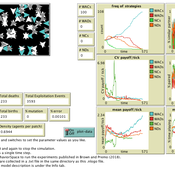
Luke Premo | Published Wednesday, April 03, 2019Previous work with the spatial iterated prisoner’s dilemma has shown that “walk away” cooperators are able to outcompete defectors as well as cooperators that do not respond to defection, but it remains to be seen just how robust the so-called walk away strategy is to ecologically important variables such as population density, error, and offspring dispersal. Our simulation experiments identify socio-ecological conditions in which natural selection favors strategies that emphasize forgiveness over flight in the spatial iterated prisoner’s dilemma. Our interesting results are best explained by considering how population density, error, and offspring dispersal affect the opportunity cost associated with walking away from an error-prone partner.
Displaying 10 of 1258 results for "Ian M Hamilton" clear search