Computational Model Library

Boyds (NetLogo): Boids That Fight (1.0.0)

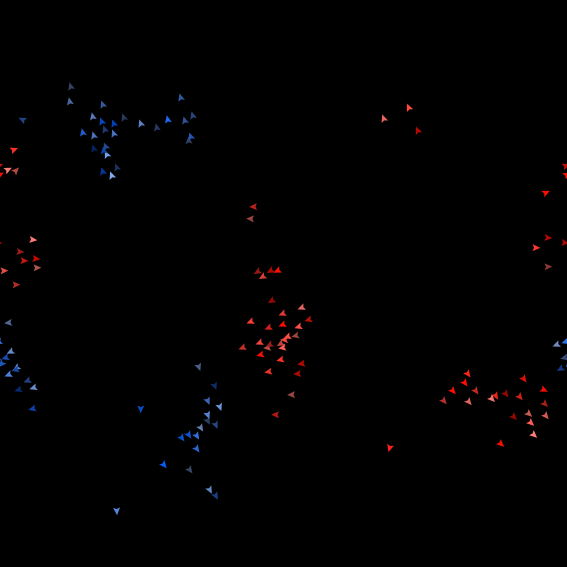
Boyds (Boids that Fight) is an agent-based model in NetLogo that extends the classic Flocking model with multi-faction competition, a local fight–flight heuristic, and a target locking/“taking” mechanism. The model separates perception (vision) from engagement range (lock distance) and uses per-faction steering bounds to explore how local numerical superiority, sensing, and bounded turning affect victory, losses, and emergent formations.
BoydsDemoImage.png

Release Notes

This is the initial public release of Boyds on CoMSES. The model was originally written for the CAS-520: Agent-Based Modeling course at Arizona State University’s School of Complex Adaptive systems, taught in Spring 2025 by Sean Bergin. The present release has only minor modifications for CoMSES compliance and user-friendliness.

Associated Publications

Boyds (NetLogo): Boids That Fight 1.0.0

Boyds (Boids that Fight) is an agent-based model in NetLogo that extends the classic Flocking model with multi-faction competition, a local fight–flight heuristic, and a target locking/“taking” mechanism. The model separates perception (vision) from engagement range (lock distance) and uses per-faction steering bounds to explore how local numerical superiority, sensing, and bounded turning affect victory, losses, and emergent formations.

Release Notes

This is the initial public release of Boyds on CoMSES. The model was originally written for the CAS-520: Agent-Based Modeling course at Arizona State University’s School of Complex Adaptive systems, taught in Spring 2025 by Sean Bergin. The present release has only minor modifications for CoMSES compliance and user-friendliness.

Version Submitter First published Last modified Status
1.0.0 Oliver M. Haynold Tue Jan 20 05:01:06 2026 Tue Jan 20 05:01:26 2026 Published Peer Reviewed DOI: 10.25937/z56b-3291

Discussion

This website uses cookies and Google Analytics to help us track user engagement and improve our site. If you'd like to know more information about what data we collect and why, please see our data privacy policy. If you continue to use this site, you consent to our use of cookies.
Accept