Computational Model Library

LogoClim: WorldClim in NetLogo (2.2.1)

LogoClim is a NetLogo model designed to be integrated into other simulations through the LevelSpace extension (Hjorth et al., 2020), providing high resolution climate data from sources validated and used by the Intergovernmental Panel on Climate Change (IPCC).

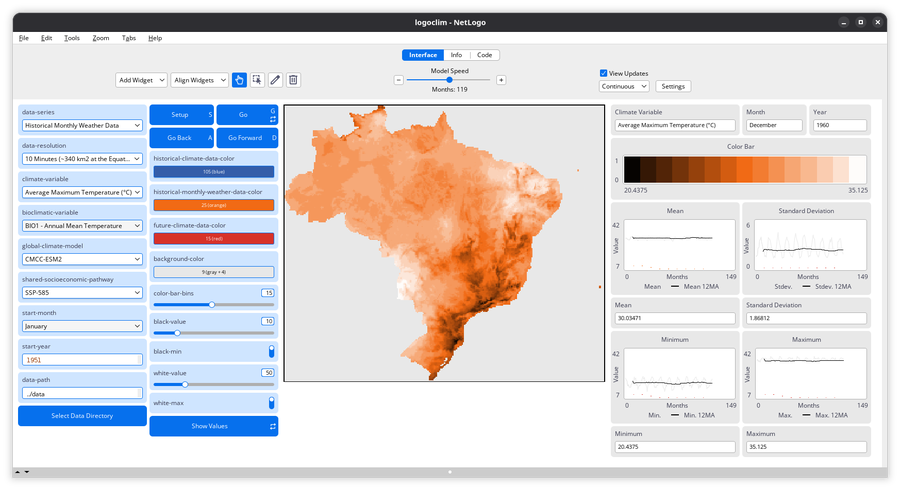
The model simplifies and standardizes the integration of climate data into NetLogo, allowing researchers to focus their efforts on the model itself with the assurance of using reliable and widely recognized data. Although its main use is as a component of larger simulations, LogoClim also has its own graphical interface for monitoring and checking the datasets.

The climate data comes from the WorldClim 2.1 project (Fick & Hijmans, 2017), for which LogoClim works as an interface to NetLogo. The model supports all three WorldClim data series: (1) Historical Climate Data (1970 to 2000), with 12 monthly points for minimum, mean, and maximum temperature, precipitation, solar radiation, wind speed, vapor pressure, elevation, and bioclimatic variables; (2) Historical Monthly Weather Data (1951 to 2024), based on downscaling of CRU-TS-4.09, developed by the Climatic Research Unit at the University of East Anglia (Harris et al., 2020), with minimum and maximum temperature and total precipitation; and (3) Future Climate Data, based on downscaling climate projections derived from global climate models of the Coupled Model Intercomparison Project Phase 6 (CMIP6) (Eyring et al., 2016) for four future periods (2021 to 2040, 2041 to 2060, 2061 to 2080, and 2081 to 2100) and four scenarios based on the Shared Socioeconomic Pathways (SSPs 126, 245, 370, and 585), covering minimum and maximum temperature, total precipitation, and bioclimatic variables. All series are available at multiple spatial resolutions, from 10 minutes (about 340 km² at the equator) to 30 seconds (about 1 km² at the equator).

The model was developed according to the FAIR principles for research software (Barker et al., 2022). It has extensive documentation and is published on GitHub and on the CoMSES Network. It recently passed a peer review for the Journal of Open Source Software (JOSS), documented in this review thread, which confirmed its technical quality, accuracy, and adherence to best practices in scientific software development.

For a deep look into the model’s structure and implementation, see the user manual.
1.png

Release Notes

Added

  • A Zenodo DOI was created for this and future releases of the project.

Changed

  • The documentation was updated.

Associated Publications

The model recently passed a peer review for the Journal of Open Source Software (JOSS), documented in this review thread. The paper will be published shortly.

LogoClim: WorldClim in NetLogo 2.2.1

LogoClim is a NetLogo model designed to be integrated into other simulations through the LevelSpace extension (Hjorth et al., 2020), providing high resolution climate data from sources validated and used by the Intergovernmental Panel on Climate Change (IPCC).

The model simplifies and standardizes the integration of climate data into NetLogo, allowing researchers to focus their efforts on the model itself with the assurance of using reliable and widely recognized data. Although its main use is as a component of larger simulations, LogoClim also has its own graphical interface for monitoring and checking the datasets.

The climate data comes from the WorldClim 2.1 project (Fick & Hijmans, 2017), for which LogoClim works as an interface to NetLogo. The model supports all three WorldClim data series: (1) Historical Climate Data (1970 to 2000), with 12 monthly points for minimum, mean, and maximum temperature, precipitation, solar radiation, wind speed, vapor pressure, elevation, and bioclimatic variables; (2) Historical Monthly Weather Data (1951 to 2024), based on downscaling of CRU-TS-4.09, developed by the Climatic Research Unit at the University of East Anglia (Harris et al., 2020), with minimum and maximum temperature and total precipitation; and (3) Future Climate Data, based on downscaling climate projections derived from global climate models of the Coupled Model Intercomparison Project Phase 6 (CMIP6) (Eyring et al., 2016) for four future periods (2021 to 2040, 2041 to 2060, 2061 to 2080, and 2081 to 2100) and four scenarios based on the Shared Socioeconomic Pathways (SSPs 126, 245, 370, and 585), covering minimum and maximum temperature, total precipitation, and bioclimatic variables. All series are available at multiple spatial resolutions, from 10 minutes (about 340 km² at the equator) to 30 seconds (about 1 km² at the equator).

The model was developed according to the FAIR principles for research software (Barker et al., 2022). It has extensive documentation and is published on GitHub and on the CoMSES Network. It recently passed a peer review for the Journal of Open Source Software (JOSS), documented in this review thread, which confirmed its technical quality, accuracy, and adherence to best practices in scientific software development.

For a deep look into the model’s structure and implementation, see the user manual.

Release Notes

Added

  • A Zenodo DOI was created for this and future releases of the project.

Changed

  • The documentation was updated.

Version Submitter First published Last modified Status
2.2.1 Daniel Vartanian Mon Jul 13 08:26:24 2026 Mon Jul 13 08:27:37 2026 Published
2.2.0 Daniel Vartanian Mon Jul 13 04:51:25 2026 Mon Jul 13 08:27:36 2026 Published
2.1.0 Daniel Vartanian Tue Sep 16 05:25:45 2025 Mon Jul 13 08:27:36 2026 Published
2.0.0 Daniel Vartanian Mon Aug 4 22:58:14 2025 Mon Jul 13 08:27:35 2026 Published
1.0.0 Daniel Vartanian Thu Jul 3 10:02:19 2025 Mon Jul 13 08:27:34 2026 Published
0.0.0 Daniel Vartanian Thu Jul 3 02:30:24 2025 Mon Jul 13 08:27:34 2026 Published

Discussion

This website uses cookies and Google Analytics to help us track user engagement and improve our site. If you'd like to know more information about what data we collect and why, please see our data privacy policy. If you continue to use this site, you consent to our use of cookies.
Accept