Our mission is to help computational modelers develop, document, and share their computational models in accordance with community standards and good open science and software engineering practices. Model authors can publish their model source code in the Computational Model Library with narrative documentation as well as metadata that supports open science and emerging norms that facilitate software citation, computational reproducibility / frictionless reuse, and interoperability. Model authors can also request private peer review of their computational models. Models that pass peer review receive a DOI once published.
All users of models published in the library must cite model authors when they use and benefit from their code.
Please check out our model publishing tutorial and feel free to contact us if you have any questions or concerns about publishing your model(s) in the Computational Model Library.
Displaying 10 of 37 results for "Manuela López" clear search

FAKENEWS-ABM: News-Source Strategies for Disseminating False News
Paul Leger Agustín Olivares Oswaldo Terán Manuela López Francis Espinoza Carolina Rodríguez Dayana Jaque | Published Wednesday, November 25, 2026An agent-based model of how a source that repeatedly publishes false news can gain audience by imitating the presentation of established media without becoming more accurate. Five hundred users repeatedly choose which of the sources they know to share from; choices follow the evidence each user has accumulated about a source’s presentation (13 attributes such as credibility, information quality, proximity and sensationalism) and recommendations from contacts. User preferences, source profiles and initial reach are derived from a survey of 507 Chilean users of X. An experimental source can copy the engagement, proximity, informational or credibility attributes of traditional media while its probability of publishing false items is held fixed. The model compares imitation strategies, campaign timing, limits on reach, and warning labels on recommended or shared items, and separates two outcomes: the source’s share of sharing decisions and the share of shared items that are false. It includes robustness variants (memory, choice rule, network, survey coding, nine-outlet ecology) and an adaptive source that learns its presentation from audience feedback.
Simulation of the Long-term Effects of Decentralized and Adaptive Investments in Cross-agency Interoperable and Standard Systems
Sungho Lee | Published Sunday, May 10, 2009 | Last modified Saturday, April 27, 2013Agent-based model using Blanche software 4.6.5. Blanche software is included in the dataset file.
Peer reviewed JuSt-Social COVID-19
Jennifer Badham | Published Thursday, June 18, 2020 | Last modified Monday, March 29, 2021NetLogo model that allows scenarios concerning general social distancing, shielding of high-risk individuals, and informing contacts when symptomatic. Documentation includes a user manual with some simple scenarios, and technical information including descriptions of key procedures and parameter values.
Stoplight parrotfish population model
Tyler Pavlowich | Published Monday, April 02, 2018This agent-based model simulates a stoplight parrotfish population in a heavily-fished Caribbean coral reef. The model allows for the simulation of various fishing regulations and observation of population and catch outcomes. It was built using the structure and equations from several previously published models, including the work of Bozec et al. (2016) and Alonzo and Mangel (2004 and 2005). The initial model conditions are parameterized to population and fishing data collected in Buen Hombre, Dominican Republic by Tyler Pavlowich.

Peer reviewed B3GET
Kristin Crouse | Published Thursday, November 14, 2019 | Last modified Thursday, August 27, 2026B3GET simulates populations of virtual organisms evolving over generations, whose evolutionary outcomes reflect the selection pressures of their environment. The model simulates several factors considered important in biology, including life history trade-offs, investment in fighting ability and aggression, sperm competition, infanticide, and competition over access to food and mates. Downloaded materials include starting genotype and population files. Edit the these files and see what changes occur in the behavior of virtual populations!
View the B3GET user manual here.
Agent-based model of risk behavior in adolescence
N Schuhmacher P Van Geert L Ballato | Published Monday, June 24, 2013 | Last modified Monday, April 08, 2019The computer model simulates the development of a social network (i.e. formation of friendships and cliques), the (dyadic) interactions between pupils and the development of similarities and differences in their behavioral profiles.
Diffusion of goods with multiple characteristics and price premiums
Pedro López Merino | Published Friday, February 18, 2022An agent-based model for the diffusion of innovations with multiple characteristics and price-premiums
NOMAD: Near–Off Mobility under Aspiration Dynamics
Alejandro Platas López | Published Wednesday, December 17, 2025NOMAD is an agent-based model of firm location choice between two aggregate regions (“near” and “off”) under logistics uncertainty. Firms occupy sites characterised by attractiveness and logistics risk, earn a risk-adjusted payoff that depends on regional costs (wages plus congestion) and an individual risk-tolerance trait, and update location choices using aspiration-based satisficing rules with switching frictions. Logistics risk evolves endogenously on occupied sites through a region-specific absorption mechanism (good/bad events that reduce/increase risk), while congestion feeds back into regional costs via regional shares and local crowding. Runs stop endogenously once the near-region share becomes quasi-stable after burn-in, and the model records time series and quasi-stable outcomes such as near/off composition, switching intensity, costs, average risk, and average risk tolerance.
NearshoreABM: production network formation under infrastructure constraints and financial frictions
Alejandro Platas López | Published Thursday, August 20, 2026NearshoreABM simulates whether a region captures the production linkages that nearshoring makes available, or fails to capture them because physical infrastructure and credit supply bind first.
The model runs over the 32 Mexican states at quarterly frequency. Multinational anchor firms decide whether to enter and where to locate, following Melitz selection on heterogeneous productivity under trade-policy uncertainty. Domestic supplier firms decide whether to formalise and whether to invest in quality, and may or may not obtain a contract with an anchor. A banking sector allocates a finite regional credit supply according to observed default risk, serving anchor firms before suppliers.
Electricity and water capacity enter production as non-linear congestion penalties with an engineering-based threshold, so the response of output to demand growth is discontinuous rather than proportional: below the threshold there is no penalty at all, between threshold and capacity the penalty grows quadratically, and above capacity it decays exponentially. Congestion is rivalrous within the quarter, which makes the order of production economically meaningful rather than incidental.
…
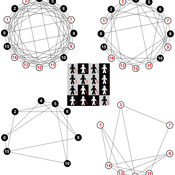
Mesoscopic Effects in an Agent-Based Bargaining Model in Regular Lattices
David Poza José Santos José Manuel Galán Ordax Adolfo López-Paredes | Published Thursday, February 02, 2017 | Last modified Wednesday, April 25, 2018We propose an agent-based model where a fixed finite population of tagged agents play iteratively the Nash demand game in a regular lattice. The model extends the bargaining model by Axtell, Epstein and Young.
Displaying 10 of 37 results for "Manuela López" clear search