Our mission is to help computational modelers develop, document, and share their computational models in accordance with community standards and good open science and software engineering practices. Model authors can publish their model source code in the Computational Model Library with narrative documentation as well as metadata that supports open science and emerging norms that facilitate software citation, computational reproducibility / frictionless reuse, and interoperability. Model authors can also request private peer review of their computational models. Models that pass peer review receive a DOI once published.
All users of models published in the library must cite model authors when they use and benefit from their code.
Please check out our model publishing tutorial and feel free to contact us if you have any questions or concerns about publishing your model(s) in the Computational Model Library.
Displaying 10 of 864 results for "Blanca Gonzalez-Mon" clear search
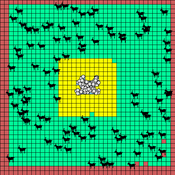
TERRoir level Organic matter Interactions and Recycling model
Myriam Grillot | Published Wednesday, April 19, 2017 | Last modified Wednesday, June 17, 2020The TERROIR agent-based model was built for the multi-level analysis of biomass and nutrient flows within agro-sylvo-pastoral villages in West Africa. It explicitly takes into account both human organization and spatial extension of such flows.
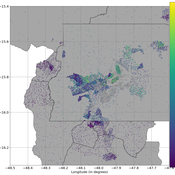
Peer reviewed PolicySpace2: modeling markets and endogenous public policies
Bernardo Furtado | Published Thursday, February 25, 2021 | Last modified Friday, January 14, 2022Policymakers decide on alternative policies facing restricted budgets and uncertain future. Designing public policies is further difficult due to the need to decide on priorities and handle effects across policies. Housing policies, specifically, involve heterogeneous characteristics of properties themselves and the intricacy of housing markets and the spatial context of cities. We propose PolicySpace2 (PS2) as an adapted and extended version of the open source PolicySpace agent-based model. PS2 is a computer simulation that relies on empirically detailed spatial data to model real estate, along with labor, credit, and goods and services markets. Interaction among workers, firms, a bank, households and municipalities follow the literature benchmarks to integrate economic, spatial and transport scholarship. PS2 is applied to a comparison among three competing public policies aimed at reducing inequality and alleviating poverty: (a) house acquisition by the government and distribution to lower income households, (b) rental vouchers, and (c) monetary aid. Within the model context, the monetary aid, that is, smaller amounts of help for a larger number of households, makes the economy perform better in terms of production, consumption, reduction of inequality, and maintenance of financial duties. PS2 as such is also a framework that may be further adapted to a number of related research questions.
Leviathan group model and its approximation
Thibaut Roubin Guillaume Deffuant | Published Tuesday, July 26, 2022The model is based on the influence function of the Leviathan model (Deffuant, Carletti, Huet 2013 and Huet and Deffuant 2017) with the addition of group idenetity. We aim at better explaining some patterns generated by this model, using a derived mathematical approximation of the evolution of the opinions averaged.
We consider agents having an opinion/esteem about each other and about themselves. During dyadic meetings, agents change their respective opinion about each other, and possibly about other agents they gossip about, with a noisy perception of the opinions of their interlocutor. Highly valued agents are more influential in such encounters. Moreover, each agent belongs to a single group and the opinions within the group are attracted to their average.
We show that a group hierarchy can emerges from this model, and that the inequality of reputations among groups have a negative effect on the opinions about the groups of low status. The mathematical analysis of the opinion dynamic shows that the lower the status of the group, the more detrimental the interactions with the agents of other groups are for the opinions about this group, especially when gossip is activated. However, the interactions between agents of the same group tend to have a positive effect on the opinions about this group.
Managing networked landscapes: conservation in fragmented, regionally connected world
Jacopo A. Baggio Michael Schoon Sechindra Vallury | Published Monday, December 09, 2019Exploring how learning and social-ecological networks influence management choice set and their ability to increase the likelihood of species coexistence (i.e. biodiversity) on a fragmented landscape controlled by different managers.

Harvesting daisies in Daisyworld
Marco Janssen | Published Saturday, July 22, 2017Comparing impact of alternative behavioral theories in a simple social-ecological system.
Value Chain Marketing (VCM)
Stephanie Hintze | Published Monday, April 14, 2014 | Last modified Thursday, October 16, 2014Inspired by the SKIN model, the basic concept here is to model the acceptance and implementation of supplier innovations. This model includes three types of agents comprising suppliers, manufacturers and applicators.
Exploration and Exploitation in Parallel Problem Solving Effect of Agent’s Imitation Strategy
Hua Zhang | Published Saturday, June 27, 2009 | Last modified Saturday, April 27, 2013I extend Lazer’s model by adding agent’s two kinds of imitation strategies: selective imitation and structurally equivalent imitation. I examined the effect of interaction of network with agent behavi
A Toy Model for the Abilene Paradox
Victor Sahin | Published Monday, June 17, 2019 | Last modified Sunday, July 14, 2019This version adds a Maslowian entropy to each agent decision based on Kendrick et. al. Rudimentary implementation assumes agents with lower scores are more likely to make decisions autonomously rather than sociotropically.
DINO model - Dynamics of Internalization and Dissemination of Norms
Marlene Batzke | Published Wednesday, January 11, 2023 | Last modified Saturday, August 19, 2023The DINO model (Dynamics of Internalization and Dissemimnation of Norms) simulates a conceptual model on the dynamics of norm internalization in the decision-making framework of a 3-person prisoner’s dilemma game.
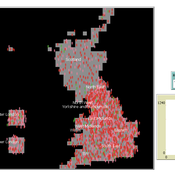
Identity and meat eating behaviour
Jiaqi Ge | Published Thursday, September 29, 2022Using data from the British Social Attitude Survey, we develop an agent-based model to study the effect of social influence on the spread of meat-eating behaviour in the British population.
Displaying 10 of 864 results for "Blanca Gonzalez-Mon" clear search