Our mission is to help computational modelers develop, document, and share their computational models in accordance with community standards and good open science and software engineering practices. Model authors can publish their model source code in the Computational Model Library with narrative documentation as well as metadata that supports open science and emerging norms that facilitate software citation, computational reproducibility / frictionless reuse, and interoperability. Model authors can also request private peer review of their computational models. Models that pass peer review receive a DOI once published.
All users of models published in the library must cite model authors when they use and benefit from their code.
Please check out our model publishing tutorial and feel free to contact us if you have any questions or concerns about publishing your model(s) in the Computational Model Library.
Displaying 10 of 1259 results for "Ian M Hamilton" clear search
Ring Around the Kula: The Influence of Ceremonial Exchange on Network Formation
Andrea Tovinen | Published Tuesday, December 16, 2008 | Last modified Saturday, April 27, 2013The purpose of the model is to examine the strength of network connections in a ceremonial exchange network in a non-hierarchical society.
Modeling Prejudice And Its Effect On Societal Prosperity
no contributors listed | Published Sunday, June 27, 2021Existing studies on prejudice, which is important in multi-group dynamics in societies, focus on the social-psychological knowledge behind the processes involving prejudice and its propagation. We instead create a multi-agent framework that simulates the propagation of prejudice and measures its tangible impact on the prosperity of individuals as well as of larger social structures, including groups and factions within. Groups in society help us define prejudice, and factions represent smaller tight-knit circles of individuals with similar opinions. We model social interactions using the Continuous Prisoner’s Dilemma (CPD) and a type of agent called a prejudiced agent, whose cooperation is affected by a prejudice attribute, updated over time based both on the agent’s own experiences and those of others in its faction. This model generates various results that both provide new insights into intergroup prejudice and its effects, as well as highlight and reinforce certain existing notions of prejudice.
Environmental uncertainty affects the optimal structure of information-sharing networks
Marco Janssen Takao Sasaki Zachary Joseph Shaffer Stephen Pratt | Published Monday, March 16, 2015We used a computer simulation to measure how well different network structures (fully connected, small world, lattice, and random) find and exploit resource peaks in a variable environment.
Tuberculosis and helminthes
Marco Janssen Nathan Rollins Alhaji Cherif Marcel Hurtado | Published Saturday, June 05, 2010 | Last modified Saturday, April 27, 2013The purpose of this model is to investigate the consequences of helminthes in public health policy to eradicate tuberculosis. Helminthes surprise immune system responses and without changes in hygiene
Hydroman is a flexible spatially explicit model coupling human and hydrological processes to explore shallow water tables and land cover interactions in flat agricultural landscapes, modeled after the Argentine Pampas. Hydroman aligned well with established hydrological models, and was validated with water table patterns and crop yield observed in the study area.
Portfolio Optimization and Trading Strategies: a simulation approach
Alessio Emanuele Biondo Laura Mazzarino | Published Sunday, March 20, 2022This model analyzes two investors forming their expectations with heterogeneous strategies in order to optimize their portfolios by means of a Sharpe ratio maximization. Traders are distinguished according to their methodology used in forecasting. Two acknowledged algorithms of technical analysis have been implemented to compare portfolios performances and assess profitability of each technique.
Patch choice model from Optimal Foraging Theory (Human Behavioral Ecology)
C Michael Barton | Published Saturday, November 22, 2008 | Last modified Saturday, April 27, 2013NetLogo model of patch choice model from optimal foraging theory (human behavioral ecology).
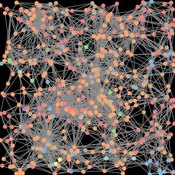
Consumats on a network
Marco Janssen | Published Tuesday, January 14, 2020 | Last modified Sunday, June 28, 2026Consumer agents make choices which products to choose using the consumat approach. In this approach agents will make choices using deliberation, repetition, imitation or social comparison dependent on the level of need satisfaction and uncertainty.
The model is discussed in Introduction to Agent-Based Modeling by Marco Janssen. For more information see https://intro2abm.com/
FEARLUS-SPOMM
Dawn Parker Gary Polhill Nick Gotts Alistair Law Luis Izquierdio Alessandro Gimona Lee-Ann Sutherland | Published Friday, March 25, 2016This is a coupled conceptual model of agricultural land decision-making and incentivisation and species metacommunities.
Modeling Arabian Upraise, a System Dynamics Approach: Egypt case study
Morteza Nazari | Published Wednesday, October 05, 2011 | Last modified Saturday, April 27, 2013A System Dynamics Model to anticipate insurgent movements and policy design to handle them .
Displaying 10 of 1259 results for "Ian M Hamilton" clear search