Our mission is to help computational modelers develop, document, and share their computational models in accordance with community standards and good open science and software engineering practices. Model authors can publish their model source code in the Computational Model Library with narrative documentation as well as metadata that supports open science and emerging norms that facilitate software citation, computational reproducibility / frictionless reuse, and interoperability. Model authors can also request private peer review of their computational models. Models that pass peer review receive a DOI once published.
All users of models published in the library must cite model authors when they use and benefit from their code.
Please check out our model publishing tutorial and feel free to contact us if you have any questions or concerns about publishing your model(s) in the Computational Model Library.
Displaying 10 of 1181 results for "Oto Hudec" clear search
Multi-level model of attitudinal dynamics
Ingo Wolf | Published Wednesday, April 06, 2016 | Last modified Wednesday, May 04, 2016A model of attitudinal dynamics based on the cognitive mechanism of emotional coherence. The code is written in Java. For initialization an additional dataset is required.
Peer reviewed Ants Digging Networks
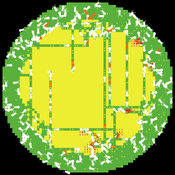
Elske van der Vaart | Published Friday, September 14, 2018This is a NetLogo version of Buhl et al.’s (2005) model of self-organised digging activity in ant colonies. It was built for a master’s course on self-organisation and its intended use is still educational. The ants’ behavior can easily be changed by toggling switches on the interface, or, for more advanced students, there is R code included allowing the model to be run and analysed through RNetLogo.
Sea Bright, NJ Reconstruction of Hurricane Sandy
Kim McEligot | Published Saturday, March 20, 2021 This model implements a combined Protective Action Decision Model (PADM) and Protection Motivation Theory (PAM) model for human decision making regarding hazard mitigations. The model is developed and integrated into the MASON modeling framework. The ABM implements a hind-cast of Hurricane Sandy’s damage to Sea Bright, NJ and homeowner post-flood reconstruction decisions. It was validated against FEMA damage assessments and post-storm surveys (O’Neil 2017).
Relational integration in schools through seating assignments
Károly Takács Marta Rado | Published Thursday, July 18, 2019We model interpersonal dynamics and study behavior in the classroom in the hypothetical case of a single teacher who defines students’ seating arrangements. The model incorporates the mechanisms of peer influence on study behavior, on attitude formation, and homophilous selection in order to depict the interrelated dynamics of networks, behavior, and attitudes. We compare various seating arrangement scenarios and observe how GPA distribution and level of prejudice changes over time.
An Agent-Based Model of Indirect Minority Influence on Social Change
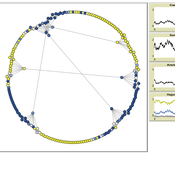
Jiin Jung | Published Wednesday, February 05, 2025This model demonstrates how different psychological mechanisms and network structures generate various patterns of cultural dynamics including cultural diversity, polarization, and majority dominance, as explored by Jung, Bramson, Crano, Page, and Miller (2021). It focuses particularly on the psychological mechanisms of indirect minority influence, a concept introduced by Serge Moscovici (1976, 1980)’s genetic model of social influence, and validates how such influence can lead to social change.
GFN & Technology Models Library (2025–2035)
natalya-pushkareva | Published Tuesday, September 15, 2026GFN & Technology Models Library (2025–2035) is a collection of four interrelated computational models focused on global financial networks, cascading default risks, technological development, and technological lag, with particular attention to Russia, the USA, and China. The library combines agent-based modeling, system dynamics, Monte-Carlo simulation, and network analysis. It includes: (1) a Numba-accelerated Monte-Carlo technology index model; (2) a hybrid GFN + cascading defaults (Gai–Kapadia) + Russian system dynamics model; (3) a twin-simulation GFN+SBS framework with selective bailout and Russia’s peripheral position; and (4) an endogenous GFN model with technology centrality, dependence, and tech lag dynamics under sanctions scenarios. GFN & Technology Models Library (2025–2035) is a collection of four interrelated computational models focused on global financial networks, cascading default risks, technological development, and technological lag, with particular attention to Russia, the USA, and China.
The library combines agent-based modeling, system dynamics, Monte-Carlo simulation, and network analysis. It includes:
- Technology Index 2035 (Monte-Carlo + Numba) — hybrid SD/ABM model projecting a composite technology index under different scenarios (Russia baseline, China, USA) with aggressive Numba optimization.
- RUS-GFN-TSI-2035 CASCADE — hybrid model integrating a Gai–Kapadia-style cascading defaults network, an agent-based Global Financial Network layer, and a system-dynamics module for the Russian economy (TSI, inflation, technology, trust, etc.).
…
Adoption of conservation practices
Irem Daloglu | Published Monday, October 21, 2013This model is designed to investigate the impact of alternative policy approaches and changing land tenure dynamics on farmer adoption of conservation practices intended to increase the water quality.
A double-layer network and the contagion mechanism of China’s financial systemic risk
zou | Published Tuesday, August 13, 2019We establish a double-layer network for China’s financial system, consisting of an interbank lending network and a cross-shareholding network. The loss of diffusion in an interbank lending channel independently, a cross-shareholding channel independently and a double-layer contagion channel after one of the financial institutions goes bankrupt with an initial shock are simulated to explore the nonlinear evolution mechanism of financial risk and impact factors of financial systemic risk in China.
Model supporting the serious game RÁC
Patrick Taillandier Alexis Drogoul Léo Biré | Published Thursday, January 25, 2024This model is supporting the serious game RÁC (“waste” in Vietnamese), dedicated to foster discussion about solid waste management in a Vietnamese commune in the Bắc Hưng Hải irrigation system.
The model is replicating waste circulation and environmental impact in four fictive villages. During the game, the players take actions and see how their decisions have an impact on the model.
This model was implemented using the GAMA platform, using gaml language.
ABM Code: Locating Cultural Holes Brokers in Diffusion Dynamics across Bright Symbolic Boundaries
Diego Leal | Published Thursday, January 23, 2025The code and data in this repository are associated with the article titled:
Leal, Diego F. 2025. “Locating Cultural Holes Brokers in Diffusion Dynamics across Bright Symbolic Boundaries.” Sociological Methods & Research OnlineFirst https://doi.org/10.1177/00491241251322517
The NetLogo code (version 6.4.0) is designed to be a standalone piece of code although it uses the ‘nw’ and ‘matrix’ extensions that come integrated with NetLogo 6.4.0. The code was ran on a Windows 10 x 64 machine.
Displaying 10 of 1181 results for "Oto Hudec" clear search