Computational Model Library

Flibs'NLogo - An elementary form of evolutionary cognition (1.1.0)

Flibs’NLogo is an agent-based simulation implemented in NetLogo that models the evolution of perfect predictors through a genetic algorithm. The agents, called flibs (finite living blobs), are finite‑state automata whose behaviour is encoded in circular chromosomes. They inhabit a “primordial computer soup” and are tasked with anticipating a user‑defined periodic binary sequence. Each generation consists of 100 evaluation cycles, during which a flib’s fitness is incremented each time its output correctly matches the next environmental signal.
Reproduction follows an elitist scheme: a donor (current fittest individual) replaces a randomly chosen recipient either by cloning (complete genome substitution) or by bacterial‑like conjugation (unidirectional horizontal transfer of a random chromosome segment). A stochastic mutagenesis operator introduces point mutations in genes, while the reproductive strategy gene can also switch under a mixed-reproduction regime. Population dynamics are monitored via genomic diversity indices (Shannon‑Wiener, Simpson), a phenotypic simpleness metric that distinguishes the low number of states actually used from the genomic potential.
The model serves as a digital evolutionary laboratory for exploring the interplay among bounded rationality, collective adaptation, and the emergence of anticipatory behaviour. By linking evolutionary computation with cognitive concepts, Flibs’NLogo investigates fundamental transitions from reactive to predictive systems and allows for testing whether populations evolve toward minimal necessary complexity or exhibit an intrinsic drift toward structural elaboration.
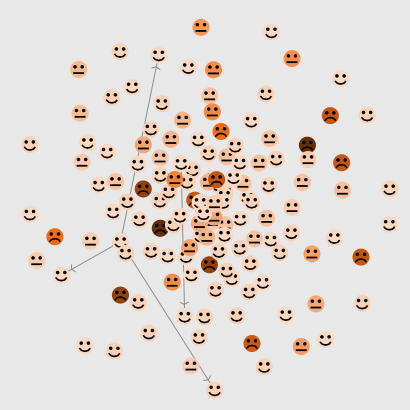
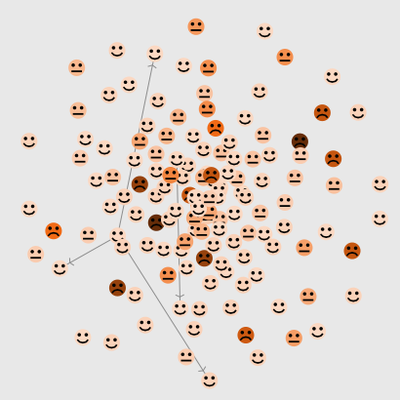
Flibs'NLogo 1.1 view.png

Release Notes

  • Upgrading to NetLogo 7.
  • The model provides a second way to initialise flib chromosomes, allowing them to start with just a single state. Over time, mutations can increase the number of states, up to a user-defined limit.
  • The mate-rate calibration has been improved.
  • The mutation-rate calibration has been enhanced to make it proportional to both the number of flibs and the number of chromosomal loci.
  • It is possible to manage flibs populations reproducing both through cloning and conjugation.
  • Genomic Entropy Tracking: integration of classical ecological diversity indices to monitor the breadth of the search space as Shannon-Wiener Index or Simpson’s Evenness.
  • Phenotypic Simpleness Detection: implementation of a new diagnostic algorithm to evaluate the “expressed phenotype” (active states), identifying agents with reduced logic to ≤ 2 states.


Associated Publications

Flibs'NLogo - An elementary form of evolutionary cognition 1.1.0

Flibs’NLogo is an agent-based simulation implemented in NetLogo that models the evolution of perfect predictors through a genetic algorithm. The agents, called flibs (finite living blobs), are finite‑state automata whose behaviour is encoded in circular chromosomes. They inhabit a “primordial computer soup” and are tasked with anticipating a user‑defined periodic binary sequence. Each generation consists of 100 evaluation cycles, during which a flib’s fitness is incremented each time its output correctly matches the next environmental signal.
Reproduction follows an elitist scheme: a donor (current fittest individual) replaces a randomly chosen recipient either by cloning (complete genome substitution) or by bacterial‑like conjugation (unidirectional horizontal transfer of a random chromosome segment). A stochastic mutagenesis operator introduces point mutations in genes, while the reproductive strategy gene can also switch under a mixed-reproduction regime. Population dynamics are monitored via genomic diversity indices (Shannon‑Wiener, Simpson), a phenotypic simpleness metric that distinguishes the low number of states actually used from the genomic potential.
The model serves as a digital evolutionary laboratory for exploring the interplay among bounded rationality, collective adaptation, and the emergence of anticipatory behaviour. By linking evolutionary computation with cognitive concepts, Flibs’NLogo investigates fundamental transitions from reactive to predictive systems and allows for testing whether populations evolve toward minimal necessary complexity or exhibit an intrinsic drift toward structural elaboration.

Release Notes

  • Upgrading to NetLogo 7.
  • The model provides a second way to initialise flib chromosomes, allowing them to start with just a single state. Over time, mutations can increase the number of states, up to a user-defined limit.
  • The mate-rate calibration has been improved.
  • The mutation-rate calibration has been enhanced to make it proportional to both the number of flibs and the number of chromosomal loci.
  • It is possible to manage flibs populations reproducing both through cloning and conjugation.
  • Genomic Entropy Tracking: integration of classical ecological diversity indices to monitor the breadth of the search space as Shannon-Wiener Index or Simpson’s Evenness.
  • Phenotypic Simpleness Detection: implementation of a new diagnostic algorithm to evaluate the “expressed phenotype” (active states), identifying agents with reduced logic to ≤ 2 states.

Version Submitter First published Last modified Status
1.1.0 Cosimo Leuci Mon Jun 15 17:52:27 2026 Mon Jun 15 18:00:41 2026 Published Peer Reviewed DOI: 10.25937/g66w-b250
1.0.0 Cosimo Leuci Thu Jan 30 08:34:19 2020 Mon Jun 15 17:41:42 2026 Published Peer Reviewed DOI: 10.25937/f932-8y73

Discussion

This website uses cookies and Google Analytics to help us track user engagement and improve our site. If you'd like to know more information about what data we collect and why, please see our data privacy policy. If you continue to use this site, you consent to our use of cookies.
Accept