Eva Vriens
ORCID more infohttps://orcid.org/0000-0003-4680-2722
GitHub more infoNo associated GitHub account.
No bio entered.
Norms@Risk ABM aim is to develop an explanation for the conditions under which people jointly take action to prevent disasters from happening, e.g. impacts from climate crisis, pandemic. The aim of the Norms@Risk work is to explore understudied dynamics between risk, social norms and cooperative behaviour and their role in overcoming collective threats. More specifically, Norms@Risk seeks to refine existing theory on cooperation by unpacking the role of collective risk interacting with social norms in ‘Collective Risk Social Dilemmas’*.
This simulation study takes on the next scientific iteration after a series of behavioural experiments. With the model we target to refine existing theory by capturing the heterogeneity in contributions that existing theories cannot fully explain as the behavioural responses are assumed to be more homogenous, particularly diversity regarding sensitivity to risk and norms.
*Collective Risk Social Dilemmas reflect a special type of social dilemma, unlike typical public goods, the collective risk dilemma involves individual contribution not to realise a gain, but to avoid a collective loss.
…
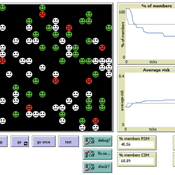
Risk-Sharing under Heterogeneity: NetLogo simulation
Eva Vriens | Published Monday, February 28, 2022Motivated by the emergence of new Peer-to-Peer insurance organizations that rethink how insurance is organized, we propose a theoretical model of decision-making in risk-sharing arrangements with risk heterogeneity and incomplete information about the risk distribution as core features. For these new, informal organisations, the available institutional solutions to heterogeneity (e.g., mandatory participation or price differentiation) are either impossible or undesirable. Hence, we need to understand the scope conditions under which individuals are motivated to participate in a bottom-up risk-sharing setting. The model puts forward participation as a utility maximizing alternative for agents with higher risk levels, who are more risk averse, are driven more by solidarity motives, and less susceptible to cost fluctuations. This basic micro-level model is used to simulate decision-making for agent populations in a dynamic, interdependent setting. Simulation results show that successful risk-sharing arrangements may work if participants are driven by motivations of solidarity or risk aversion, but this is less likely in populations more heterogeneous in risk, as the individual motivations can less often make up for the larger cost deficiencies. At the same time, more heterogeneous groups deal better with uncertainty and temporary cost fluctuations than more homogeneous populations do. In the latter, cascades following temporary peaks in support requests more often result in complete failure, while under full information about the risk distribution this would not have happened.
Under development.