Computational Model Library

Navigating complex ethical landscapes with agent-based modeling: The Yard Sale model (1.0.0)

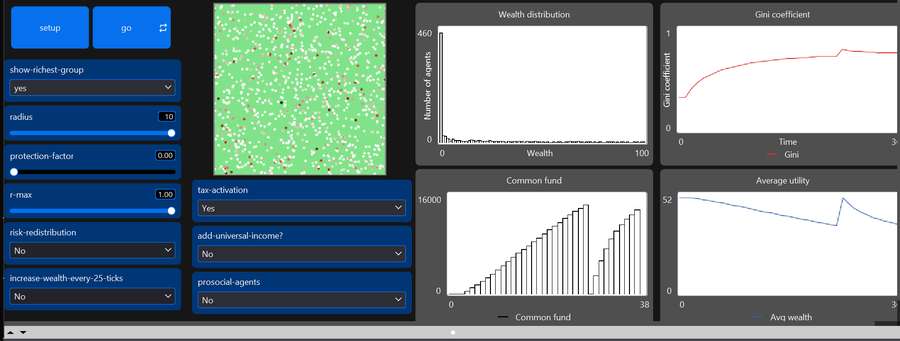
This article builds on the ideas of Hayes (2002) (see Hayes, B. (2002). Follow the Money, American Scientist 90(5), 400, doi:10.1511/2002.33.3291) on the rise of inequality in economic exchange, using the analogy of a yard sale exchange. The Yard Sale model illustrates how inequality can emerge among traders that initially have a homogeneous wealth distribution. We explore ethics interventions applying the six ethics lenses framework, as defined by the Markkula Center for Applied Ethics (Santa Clara University) through the Yard Sale model.

The baseline conditions of the model assume a radius of interaction = 10, a protection factor = 0, a risk upper bound = 1, no risk and wealth distribution mechanisms, no taxes, and no universal income, and absence of prosocial agents. Variations of these factor are associated with severla ethics related interventions to mitigate inequality. There are six ethics lenses, which are explained next.
YSModel_Screenshot.png

Release Notes

First release.

Associated Publications

Navigating complex ethical landscapes with agent-based modeling: The Yard Sale model 1.0.0

This article builds on the ideas of Hayes (2002) (see Hayes, B. (2002). Follow the Money, American Scientist 90(5), 400, doi:10.1511/2002.33.3291) on the rise of inequality in economic exchange, using the analogy of a yard sale exchange. The Yard Sale model illustrates how inequality can emerge among traders that initially have a homogeneous wealth distribution. We explore ethics interventions applying the six ethics lenses framework, as defined by the Markkula Center for Applied Ethics (Santa Clara University) through the Yard Sale model.

The baseline conditions of the model assume a radius of interaction = 10, a protection factor = 0, a risk upper bound = 1, no risk and wealth distribution mechanisms, no taxes, and no universal income, and absence of prosocial agents. Variations of these factor are associated with severla ethics related interventions to mitigate inequality. There are six ethics lenses, which are explained next.

Release Notes

First release.

Version Submitter First published Last modified Status
1.0.0 César García-Díaz Mon Nov 9 17:13:29 2026 Mon Nov 9 17:14:55 2026 Published

Discussion

This website uses cookies and Google Analytics to help us track user engagement and improve our site. If you'd like to know more information about what data we collect and why, please see our data privacy policy. If you continue to use this site, you consent to our use of cookies.
Accept