Our mission is to help computational modelers develop, document, and share their computational models in accordance with community standards and good open science and software engineering practices. Model authors can publish their model source code in the Computational Model Library with narrative documentation as well as metadata that supports open science and emerging norms that facilitate software citation, computational reproducibility / frictionless reuse, and interoperability. Model authors can also request private peer review of their computational models. Models that pass peer review receive a DOI once published.
All users of models published in the library must cite model authors when they use and benefit from their code.
Please check out our model publishing tutorial and feel free to contact us if you have any questions or concerns about publishing your model(s) in the Computational Model Library.
Displaying 10 of 33 results for "Adolfo López-Paredes" clear search
Tiebout sorting
Marco Janssen | Published Thursday, January 24, 2019This Netlogo replication of Kollman, K., J.H. Miller and S.E. Page (1997) Political Institutions and Sorting in a Tiebout Model, American Economic Review 87(5): 977-992. The model consists of of citizens who can vote for partie and move to other jurisdictions if they expect their preferences are better served. Parties adjust their positions to increase their share in the elections.
The effect of error on cultural transmission
Claudine Gravel-Miguel | Published Thursday, November 01, 2012 | Last modified Saturday, April 27, 2013This is the replication of the experiment performed by Eerkens and Lipo (2005) to look at the effect of copying errors when specific traits are transferred from an individual to another.
Contract farming in the Mekong Delta's rice supply chain
Hung Nguyen | Published Tuesday, February 05, 2019We study three obstacles of the expansion of contract rice farming in the Mekong Delta (MKD) region. The failure of buyers in building trust-based relationship with small-holder farmers, unattractive offered prices from the contract farming scheme, and limited rice processing capacity have constrained contractors from participating in the large-scale paddy field program. We present an agent-based model to examine the viability of contract farming in the region from the contractor perspective.
The model focuses on financial incentives and trust, which affect the decision of relevant parties on whether to participate and honor a contract. The model is also designed in the context of the MKD’s rice supply chain with two contractors engaging in the contract rice farming scheme alongside an open market, in which both parties can renege on the agreement. We then evaluate the contractors’ performances with different combinations of scenarios related to the three obstacles.
Our results firstly show that a fully-equipped contractor who opportunistically exploits a relatively small proportion (less than 10%) of the contracted farmers in most instances can outperform spot market-based contractors in terms of average profit achieved for each crop. Secondly, a committed contractor who offers lower purchasing prices than the most typical rate can obtain better earnings per ton of rice as well as higher profit per crop. However, those contractors in both cases could not enlarge their contract farming scheme, since either farmers’ trust toward them decreases gradually or their offers are unable to compete with the benefits from a competitor or the spot market. Thirdly, the results are also in agreement with the existing literature that the contract farming scheme is not a cost-effective method for buyers with limited rice processing capacity, which is a common situation among the contractors in the MKD region.
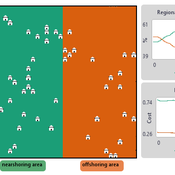
NOMAD: Near–Off Mobility under Aspiration Dynamics
Alejandro Platas López | Published Wednesday, December 17, 2025NOMAD is an agent-based model of firm location choice between two aggregate regions (“near” and “off”) under logistics uncertainty. Firms occupy sites characterised by attractiveness and logistics risk, earn a risk-adjusted payoff that depends on regional costs (wages plus congestion) and an individual risk-tolerance trait, and update location choices using aspiration-based satisficing rules with switching frictions. Logistics risk evolves endogenously on occupied sites through a region-specific absorption mechanism (good/bad events that reduce/increase risk), while congestion feeds back into regional costs via regional shares and local crowding. Runs stop endogenously once the near-region share becomes quasi-stable after burn-in, and the model records time series and quasi-stable outcomes such as near/off composition, switching intensity, costs, average risk, and average risk tolerance.
NearshoreABM: production network formation under infrastructure constraints and financial frictions
Alejandro Platas López | Published Thursday, August 20, 2026NearshoreABM simulates whether a region captures the production linkages that nearshoring makes available, or fails to capture them because physical infrastructure and credit supply bind first.
The model runs over the 32 Mexican states at quarterly frequency. Multinational anchor firms decide whether to enter and where to locate, following Melitz selection on heterogeneous productivity under trade-policy uncertainty. Domestic supplier firms decide whether to formalise and whether to invest in quality, and may or may not obtain a contract with an anchor. A banking sector allocates a finite regional credit supply according to observed default risk, serving anchor firms before suppliers.
Electricity and water capacity enter production as non-linear congestion penalties with an engineering-based threshold, so the response of output to demand growth is discontinuous rather than proportional: below the threshold there is no penalty at all, between threshold and capacity the penalty grows quadratically, and above capacity it decays exponentially. Congestion is rivalrous within the quarter, which makes the order of production economically meaningful rather than incidental.
…
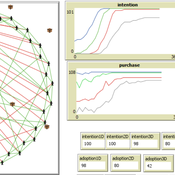
Diffusion of goods with multiple characteristics and price premiums
Pedro López Merino | Published Friday, February 18, 2022An agent-based model for the diffusion of innovations with multiple characteristics and price-premiums
Policies to reconnect a city and the countryside
Gert Jan Hofstede Tim Verwaart | Published Monday, September 23, 2019The agent-based model captures the spatio-temporal institutional dynamics of the economy over the years at the level of a Dutch province. After 1945, Noord-Brabant in the Netherlands has been subject to an active program of economic development through the stimulation of pig husbandry. This has had far-reaching effects on its economy, landscape, and environment. The agents are households. The simulation is at institutional level, with typical stakeholder groups, lobbies, and political parties playing a role in determining policies that in turn determine economic, spatial and ecological outcomes. It allows to experiment with alternative scenarios based on two political dimensions: local versus global issues, and economic versus social responsibilitypriorities. The model shows very strong sensitivity to political context. It can serve as a reference model for other cases where “artificial institutional economics” is attempted.
A spatial model of resource-consumer dynamics
Arend Ligtenberg Guus Ten Broeke George Ak Van Voorn Jaap Molenaar | Published Wednesday, January 11, 2017 | Last modified Thursday, September 17, 2020The model simulates agents in a spatial environment competing for a common resource that grows on patches. The resource is converted to energy, which is needed for performing actions and for surviving.
Modeling information Asymmetries in Tourism
Jacopo A. Baggio Rodolfo Baggio | Published Monday, January 09, 2012 | Last modified Saturday, April 27, 2013A very simple model elaborated to explore what may happens when buyers (travelers) have more information than sellers (tourist destinations)
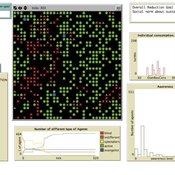
Peer reviewed A model of environmental awareness spread and its effect in resource consumption reduction
Giovanna Sissa | Published Sunday, June 21, 2015 | Last modified Monday, August 17, 2015The model reproduces the spread of environmental awareness among agents and the impact of awareness level of the agents on the consumption of a resource, like energy. An agent is a household with a set of available advanced smart metering functions.
Displaying 10 of 33 results for "Adolfo López-Paredes" clear search