Our mission is to help computational modelers develop, document, and share their computational models in accordance with community standards and good open science and software engineering practices. Model authors can publish their model source code in the Computational Model Library with narrative documentation as well as metadata that supports open science and emerging norms that facilitate software citation, computational reproducibility / frictionless reuse, and interoperability. Model authors can also request private peer review of their computational models. Models that pass peer review receive a DOI once published.
All users of models published in the library must cite model authors when they use and benefit from their code.
Please check out our model publishing tutorial and feel free to contact us if you have any questions or concerns about publishing your model(s) in the Computational Model Library.
Displaying 2 of 132 results for "Jean-Philippe Choisis" clear search
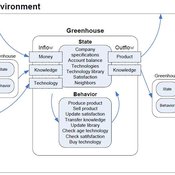
Universal Darwinism in Dutch Greenhouses
Julia Kasmire | Published Wednesday, May 09, 2012 | Last modified Saturday, April 27, 2013An ABM, derived from a case study and a series of surveys with greenhouse growers in the Westland, Netherlands. Experiments using this model showshow that the greenhouse horticulture industry displays diversity, adaptive complexity and an uneven distribution, which all suggest that the industry is an evolving system.
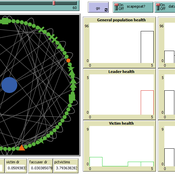
An agent-based model of scapegoating
Carlos Paes | Published Thursday, August 28, 2025 | Last modified Thursday, August 28, 2025An agent-based model of the scapegoat mechanism of René Girard’s mimetic theory on a coevolving network. Agents accumulate tension from a shared stressor and from contagion; an agent whose whole neighbourhood is saturated accuses another; ties reorganise around accusers; once the marked exceed a tenth of the living, a threshold rule expels one of them and the group’s tension is discharged. The model asks when a stressed population reaches the collective act, what it costs and what it leaves behind: without the accusation rules tension saturates and most of the population dies; with them tension stays low and the cost falls on a few; closure (the reluctance to form new ties) decides whether expulsion occurs and skepticism decides when; the act’s lasting mark is a lower division into communities. A null model, the ablation of each rule, six initial networks and controls on the reach of the relief test the results. Release 1.1.0 is the package behind a manuscript submitted to JASSS (November 2026): six model versions, the per-tick output of every series, daily aggregates of eight anonymised episodes of online hostility and the scripts that regenerate every table and figure. Releases 1.0.x hold an earlier version of the model alone.
Displaying 2 of 132 results for "Jean-Philippe Choisis" clear search