Our mission is to help computational modelers develop, document, and share their computational models in accordance with community standards and good open science and software engineering practices. Model authors can publish their model source code in the Computational Model Library with narrative documentation as well as metadata that supports open science and emerging norms that facilitate software citation, computational reproducibility / frictionless reuse, and interoperability. Model authors can also request private peer review of their computational models. Models that pass peer review receive a DOI once published.
All users of models published in the library must cite model authors when they use and benefit from their code.
Please check out our model publishing tutorial and feel free to contact us if you have any questions or concerns about publishing your model(s) in the Computational Model Library.
Displaying 5 of 5 results sports clear search
Margin League: Elo forecasts, bookmaker margin and the favourite-longshot pattern
Edward | Published Sunday, November 15, 2026An agent-based model of a sports league, a public Elo forecaster and a bookmaker. Teams have hidden true strengths that drift between seasons; the forecaster updates Elo ratings after every game; the bookmaker prices each game from the Elo forecast plus a margin (overround), spread either proportionally or loaded onto longshot prices. The model asks where the favourite-longshot pattern in betting prices comes from. With a forecaster whose ratings lag true strength, longshots win more often than their de-vigged price implies; a bookmaker that loads its margin onto longshots cancels that bias, so favourite and longshot bets both lose roughly the margin. Outputs: a calibration table (de-vigged price band vs. observed win rate) and the average return of flat bets on favourites and longshots. Python 3 standard library only; all parameters are command-line arguments; the README documents the model with a short ODD protocol and an example run. Companion empirical study and open data (CC BY 4.0): Bet Better market calibration study. Teaching model, not a betting system.
Peer reviewed LSCs-CF: An agent-based model of public space conditions and the collective formation of local sports communities
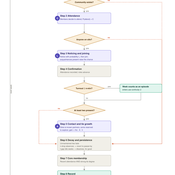
Yijia JIANG | Published Thursday, August 13, 2026 | Last modified Thursday, August 20, 2026An agent-based model of how public space conditions shape the collective formation of local sports communities in high-mobility cities. A small gathering is already exercising in an abstract, systematically configurable public space; the model asks how strangers join them and whether the loose gathering consolidates into a stable community. Three conditions are manipulated, each acting through exactly one channel: spatial legibility governs whether a passer-by notices the activity, routine compatibility governs whether a member attends in a given week, and social anchor availability governs how much one episode of co-presence builds a tie. Ties carry a continuous strength with two thresholds, so that relationships of differing strength cross their thresholds at different condition levels. Because the model does not represent the origin of an activity, dissolution is irreversible and survival is a clean binary outcome. Across 32,790 runs in eight experiments the model yields two well separated thresholds along routine compatibility — one for survival, one for consolidation — with a wide band between them in which a space is used continuously but no community forms. The tie submodel is adapted from Jin, Girvan and Newman (2001) and verified against it by docking. Robustness is established against the seeded gathering, the pre-existing social network, a joint ±20 per cent perturbation of the behavioural parameters, and the parameters of the tie machinery.
Drafting agent-based modeling into basketball analytics
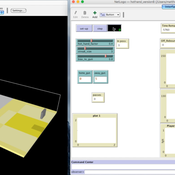
Matthew Oldham | Published Tuesday, February 19, 2019An agent-based simulation of a game of basketball. The model implements most components of a standard game of basketball. Additionally, the model allows the user to test for the effect of two separate cognitive biases – the hot-hand effect and a belief in the team’s franchise player.
Agent-based model of risk behavior in adolescence
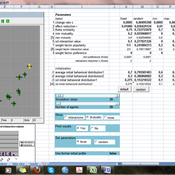
N Schuhmacher P Van Geert L Ballato | Published Monday, June 24, 2013 | Last modified Monday, April 08, 2019The computer model simulates the development of a social network (i.e. formation of friendships and cliques), the (dyadic) interactions between pupils and the development of similarities and differences in their behavioral profiles.
Optimal Trading Strategies of Agents in a Population of Firms: An Agent-Based Approach to Soccer Transfer Markets
Kehinde Salau | Published Tuesday, December 16, 2008 | Last modified Saturday, April 27, 2013Default Initial skill, read ODD for more info. The purpose of the model presented by Salau is to study the ’player profit vs. club benefit’ dilemma present in professional soccer organizations.