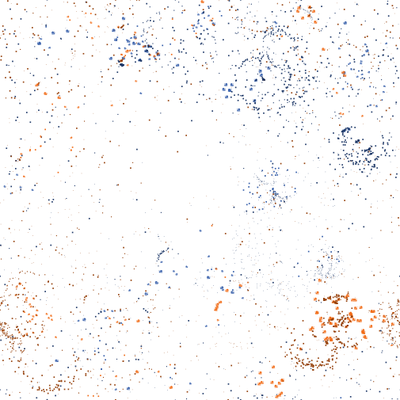
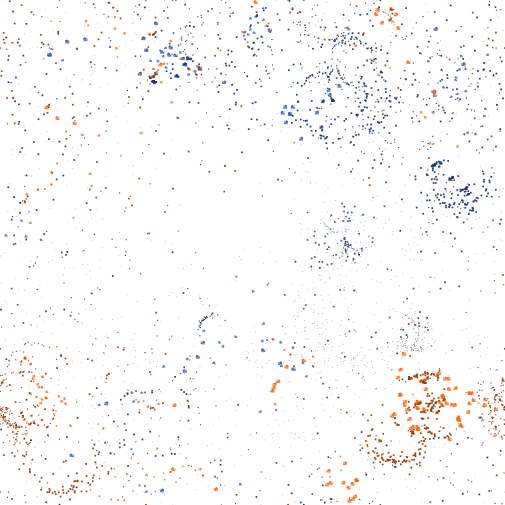
Evolution of Sex is a NetLogo model that illustrates the advantages and disadvantages of sexual and asexual reproductive strategies. It seeks to demonstrate the answer to the question: “Why do we have sex?” After all, wouldn’t it be a better strategy to simply clone yourself? There are many advantages to asexual reproduction:
Your offspring possess all of your own genetic material.
You get to make a copy of 100% of your genes.
You don’t have to worry about finding a mate.
Conversely, there are many disadvantages to sexual reproduction:
You have to share your genetic material with an unrelated individual.
You get to make a copy of only 50% of your genes.
You have to expend time and energy looking for and obtaining a mate.
From this, it may seem like sexual reproduction is an evolutionary puzzle as it appears too costly to ever be advantageous. However, as this model shows, under certain conditions, a sexual reproductive strategy can win out over an asexual strategy. By introducing parasites to the environment, it creates a selective pressure that makes it more advantageous NOT to simply make a clone of yourself! The reason is simple: if a parasite can infect you, it can also infect all of your clones. However, if your offspring only obtain 50% of their genetic material from you, they are less likely to be susceptible to the same parasite that can infect you. Sexual reproducers are able to mix their genetic material in ways that produce new combinations that parasites have not yet evolved to attack. In short, in the arms race between the hosts and the parasites, sexually reproducing hosts are able to keep up much better than asexually reproducing hosts can.
Release Notes
Evolution of Sex (Version 1.2.0)
Version 1.2.0 refines the original Evolution of Sex model to improve ecological realism, clarity, and instructional usability while preserving its core evolutionary dynamics. The model now consistently refers to hosts as Snails and replaces density-based host limits with an explicit snail-carrying-capacity, implementing smooth logistic population regulation rather than abrupt culling. The parasite infection probability is displayed as a percentage for improved interpretability.
Parasite dynamics have been enhanced with per-snail-parasite-capacity, introducing host-level density dependence that prevents unrealistic parasite overgrowth while maintaining Red Queen coevolutionary dynamics. The simulation loop has been modularized and optimized for performance, with encounter probabilities and crowding effects calculated once per tick.
A new show-strategies visualization option displays fading spatial trails (light gray for asexual, dark gray for sexual) to illustrate how reproductive strategies spread and cluster over time. Updated ODD documentation reflects all structural and conceptual changes.
These revisions make the model more intuitive for students while retaining its function as a demonstration of parasite-mediated selection and the evolution of sex.
Associated Publications
This release is out-of-date. The latest version is
1.2.1
Evolution of Sex 1.2.0
Submitted byKristin CrousePublished Feb 16, 2026
Last modified Feb 18, 2026
Evolution of Sex is a NetLogo model that illustrates the advantages and disadvantages of sexual and asexual reproductive strategies. It seeks to demonstrate the answer to the question: “Why do we have sex?” After all, wouldn’t it be a better strategy to simply clone yourself? There are many advantages to asexual reproduction:
Your offspring possess all of your own genetic material.
You get to make a copy of 100% of your genes.
You don’t have to worry about finding a mate.
Conversely, there are many disadvantages to sexual reproduction:
You have to share your genetic material with an unrelated individual.
You get to make a copy of only 50% of your genes.
You have to expend time and energy looking for and obtaining a mate.
From this, it may seem like sexual reproduction is an evolutionary puzzle as it appears too costly to ever be advantageous. However, as this model shows, under certain conditions, a sexual reproductive strategy can win out over an asexual strategy. By introducing parasites to the environment, it creates a selective pressure that makes it more advantageous NOT to simply make a clone of yourself! The reason is simple: if a parasite can infect you, it can also infect all of your clones. However, if your offspring only obtain 50% of their genetic material from you, they are less likely to be susceptible to the same parasite that can infect you. Sexual reproducers are able to mix their genetic material in ways that produce new combinations that parasites have not yet evolved to attack. In short, in the arms race between the hosts and the parasites, sexually reproducing hosts are able to keep up much better than asexually reproducing hosts can.
Release Notes
Evolution of Sex (Version 1.2.0)
Version 1.2.0 refines the original Evolution of Sex model to improve ecological realism, clarity, and instructional usability while preserving its core evolutionary dynamics. The model now consistently refers to hosts as Snails and replaces density-based host limits with an explicit snail-carrying-capacity, implementing smooth logistic population regulation rather than abrupt culling. The parasite infection probability is displayed as a percentage for improved interpretability.
Parasite dynamics have been enhanced with per-snail-parasite-capacity, introducing host-level density dependence that prevents unrealistic parasite overgrowth while maintaining Red Queen coevolutionary dynamics. The simulation loop has been modularized and optimized for performance, with encounter probabilities and crowding effects calculated once per tick.
A new show-strategies visualization option displays fading spatial trails (light gray for asexual, dark gray for sexual) to illustrate how reproductive strategies spread and cluster over time. Updated ODD documentation reflects all structural and conceptual changes.
These revisions make the model more intuitive for students while retaining its function as a demonstration of parasite-mediated selection and the evolution of sex.
This website uses cookies and Google Analytics to help us track user engagement and improve our site. If
you'd like to know more information about what data we collect and why, please see
our data privacy policy. If you continue to use this site, you consent to
our use of cookies.