Our mission is to help computational modelers develop, document, and share their computational models in accordance with community standards and good open science and software engineering practices. Model authors can publish their model source code in the Computational Model Library with narrative documentation as well as metadata that supports open science and emerging norms that facilitate software citation, computational reproducibility / frictionless reuse, and interoperability. Model authors can also request private peer review of their computational models. Models that pass peer review receive a DOI once published.
All users of models published in the library must cite model authors when they use and benefit from their code.
Please check out our model publishing tutorial and feel free to contact us if you have any questions or concerns about publishing your model(s) in the Computational Model Library.
Displaying 2 of 2 results meadow clear search
Peer reviewed MUTUS (Mutualism in Texts and Understanding of Students)
Yevgeny Patarakin | Published Sunday, November 22, 2026MUTUS: A Mutualistic-Network Agent-Based Model of Pollinators and Flowers, Students and Wiki Texts
MUTUS (Mutualism in Texts and Understanding of Students) is a minimal agent-based model of a mutualistic network between two guilds. One computational core supports two worlds. In the meadow, pollinators visit flowering plants; in the wiki, students of a course read and improve the articles of a course wiki. Trait matching is the shared mechanism: proboscis length vs. corolla depth in the meadow, and competence vs. conceptual difficulty, read as the zone of proximal development (ZPD), in the wiki. The two worlds differ only in a small set of fixed world constants: the width and asymmetry of the ZPD band, the efficiency of transfer between clusters (species or topics), scaffolding of difficulty by text quality, and the decay of novelty and quality. The model asks which regularities of plant–pollinator networks transfer to collaborative text production, and which are changed by processes that are slow or absent in ecology: learning, scaffolding, and authoring of new texts by the learners themselves
Modelling the effects of mowing regimes on arthropod abundance in grasslands of Lüneburg
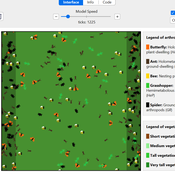
Johanna Augustin Joanna-173 | Published Tuesday, August 25, 2026This NetLogo model simulates the impact of mowing frequency, mower type and the percentage of refuge strips on the abundance of arthropods in managed grasslands. It represents five functional arthropod groups: holometabolous plant-dwelling arthropods (HoP, represented by butterflies); holometabolous ground-dwelling arthropods (HoG, represented by ants); nesting pollinators (NP, represented by bees); hemimetabolous plant-dwelling arthropods (HeP, represented by grasshoppers); and ground-resident arthropods (GR, represented by spiders). Three mowing frequencies are simulated: intensive (four mowings per year), intermediate (two mowings per year) and extensive (one mowing per year). Bar and disc mowers differ in their effects on arthropod mortality and vegetation height. Refuge strip coverage can be set to 0%, 10% or 20%. Arthropod abundance changes over time through movement, reproduction, natural mortality, mower-related mortality and vegetation regrowth.