Our mission is to help computational modelers develop, document, and share their computational models in accordance with community standards and good open science and software engineering practices. Model authors can publish their model source code in the Computational Model Library with narrative documentation as well as metadata that supports open science and emerging norms that facilitate software citation, computational reproducibility / frictionless reuse, and interoperability. Model authors can also request private peer review of their computational models. Models that pass peer review receive a DOI once published.
All users of models published in the library must cite model authors when they use and benefit from their code.
Please check out our model publishing tutorial and feel free to contact us if you have any questions or concerns about publishing your model(s) in the Computational Model Library.
Displaying 3 of 3 results human capital clear search
Denatocracy: Allocating Opportunity by Potential and Will
Nicholas Harkiolakis | Published Wednesday, November 04, 2026This model compares rules for allocating a fixed budget of opportunity (places, training, funding) among people who differ in potential and will. Each agent’s effective potential, its denatotita, is potential multiplied by will. Realisation is denatotita multiplied by the opportunity received, and an agent succeeds when realisation reaches a threshold. Nine allocation regimes are compared: equal shares; shares proportional to denatotita; three threshold rules that reclaim and redistribute the allocations of those who would fail; an efficient benchmark that maximises successes; and three forward-looking rules (foresight, will-aware foresight and hindsight). A mixed regime blends targeting with equal shares. Over time, opportunity develops potential through a skill-formation technology, and will rises with success and falls when an agent is passed over. The model reproduces the article’s results: a closed-form crossover between equal and proportional allocation; a reversal in favour of broad allocation when development is productive; a hollowing-out of potential under success-maximising allocation; and the failure of mixtures of targeting and equal shares. Written in Python (NumPy, pandas, Matplotlib), with fixed random seeds so results are exactly reproducible.
U-TRANS Modelling Urban Transition with Coupled Housing and Labour Markets
Bernardo Furtado Jiaqi Ge | Published Monday, July 31, 2023We develop an agent-based model (U-TRANS) to simulate the transition of an abstract city under an industrial revolution. By coupling the labour and housing markets, we propose a holistic framework that incorporates the key interacting factors and micro processes during the transition. Using U-TRANS, we look at five urban transition scenarios: collapse, weak recovery, transition, enhanced training and global recruit, and find the model is able to generate patterns observed in the real world. For example, We find that poor neighbourhoods benefit the most from growth in the new industry, whereas the rich neighbourhoods do better than the rest when the growth is slow or the situation deteriorates. We also find a (subtle) trade-off between growth and equality. The strategy to recruit a large number of skilled workers globally will lead to higher growth in GDP, population and human capital, but it will also entail higher inequality and market volatility, and potentially create a divide between the local and international workers. The holistic framework developed in this paper will help us better understand urban transition and detect early signals in the process. It can also be used as a test-bed for policy and growth strategies to help a city during a major economic and technological revolution.
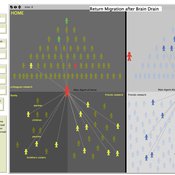
RETURN MIGRATION AFTER BRAIN DRAIN: A SIMULATION APPROACH
Alessio Emanuele Biondo Alessandro Pluchino Andrea Rapisarda | Published Friday, June 21, 2013This model, realized on the NetLogo platform, compares utility levels at home and abroad to simulate agents’ migration and their eventual return. Our model is based on two fundamental individual features, i.e. risk aversion and initial expectation, which characterize the dynamics of different agents according to the evolution of their social contacts.