Our mission is to help computational modelers develop, document, and share their computational models in accordance with community standards and good open science and software engineering practices. Model authors can publish their model source code in the Computational Model Library with narrative documentation as well as metadata that supports open science and emerging norms that facilitate software citation, computational reproducibility / frictionless reuse, and interoperability. Model authors can also request private peer review of their computational models. Models that pass peer review receive a DOI once published.
All users of models published in the library must cite model authors when they use and benefit from their code.
Please check out our model publishing tutorial and feel free to contact us if you have any questions or concerns about publishing your model(s) in the Computational Model Library.
Displaying 3 of 3 results collective identity clear search
The emergence of new market logics in sustainable food
César García-Díaz | Published Friday, October 30, 2026The model represents a large, traditional firm competing with small, sustainable food producers. The large firm operates under conventional assumptions, pursuing monopoly profits maximized through standard economic principles. Its behavior is driven by economies of scale, which compel small firms to strategically differentiate themselves to deliver added value to consumers. Consequently, small firms focus on offering higher-quality products—a factor that matters significantly to consumers.
The gains achieved by small firms represent social profits that hinge upon establishing co-participation schemes with farmers and building trustworthy relationships with consumers. Cooperation with farmers directly shapes production processes and product quality. Because a firm trusted by one consumer becomes visible to neighbors, trust can diffuse and evolve into a collective identity. Ultimately, population-level legitimation occurs when the organizational form of the organic food producer gains widespread acceptance within the consumer community.
The model’s behavior depends on three key factors: a trust parameter, a legitimation intensity parameter, and an aspiration-level weight (for the large firm).
Identity Fusion Group Behaviour Simulator
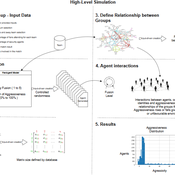
Leonardo D. Martins Araujo Roberto Cesar Betini | Published Monday, June 03, 2024The model is based on Swann and Buhrmester’s Identity Fusion behavioural theory, which seeks to explain why an individual puts the group’s priorities above their personal expectations. In order to observe the theory and validate group behaviour, a case study was carried out focusing on scenarios of group violence in football stadiums in Brazil. For the modelling, each agent has a distribution of levels of identification with the group to which they belong, with their level of fusion varying between 1 and 5. According to behavioural theory, an individual’s degree of fusion with the group directly interferes with their behaviour of replicating actions and absorbing group beliefs.
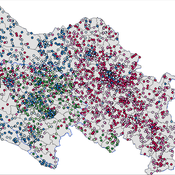
This is the final version of the model. To simulate the normative dynamics we used the EmIL (EMergence In the Loop) Framework which was kindly provided by Ulf Lotzmann. http://cfpm.org/EMIL-D5.1.pdf