Our mission is to help computational modelers develop, document, and share their computational models in accordance with community standards and good open science and software engineering practices. Model authors can publish their model source code in the Computational Model Library with narrative documentation as well as metadata that supports open science and emerging norms that facilitate software citation, computational reproducibility / frictionless reuse, and interoperability. Model authors can also request private peer review of their computational models. Models that pass peer review receive a DOI once published.
All users of models published in the library must cite model authors when they use and benefit from their code.
Please check out our model publishing tutorial and feel free to contact us if you have any questions or concerns about publishing your model(s) in the Computational Model Library.
Displaying 10 of 396 results for "Tim Gooding" clear search
ABM Simulation of Transition from Late Longshan Cultures to Early Erlitou Culture
Carmen Iasiello | Published Sunday, November 26, 2023Within the archeological record for Bronze Age Chinese culture, there continues to be a gap in our understanding of the sudden rise of the Erlitou State from the previous late Longshan chiefdoms. In order to examine this period, I developed and used an agent-based model (ABM) to explore possible socio-politically relevant hypotheses for the gap between the demise of the late Longshan cultures and rise of the first state level society in East Asia. I tested land use strategy making and collective action in response to drought and flooding scenarios, the two plausible environmental hazards at that time. The model results show cases of emergent behavior where an increase in social complexity could have been experienced if a catastrophic event occurred while the population was sufficiently prepared for a different catastrophe, suggesting a plausible lead for future research into determining the life of the time period.
The ABM published here was originally developed in 2016 and its results published in the Proceedings of the 2017 Winter Simulation Conference.
Social norms and the dominance of Low-doers
Antonio Franco | Published Wednesday, July 13, 2016 | Last modified Sunday, December 02, 2018The code for the paper “Social norms and the dominance of Low-doers”
Online Collaboration, Competing for Attention
M Manning | Published Wednesday, July 19, 2017 | Last modified Thursday, January 24, 2019This is a model of a community of online communities. Using mechanisms such as win-stay, lose-shift, and preferential attachment the model can reproduce similar patterns to those of the Stack Exchange network.
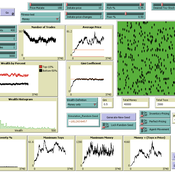
Toy Trader 2019
Timothy Gooding | Published Sunday, February 24, 2019A model that strips trade down to its core to explore foundational emergent behaviour and evolution in trade systems.
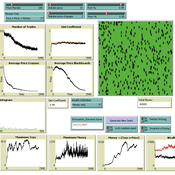
Three-Goods Trader 2019
Timothy Gooding | Published Sunday, February 24, 2019This is the Toy Trader but with two additional goods being traded.
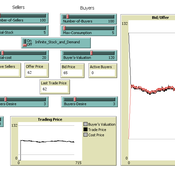
Double Auction
Timothy Gooding | Published Sunday, February 24, 2019This model reproduces the double auction experiments and explores the difference between short-term and long-term trading and pricing.
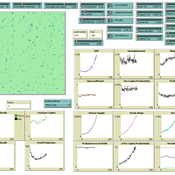
Metaphoria 2019
Timothy Gooding | Published Sunday, February 24, 2019This model test the efficiency of the market economy in comparison with a hunter/gatherer economy. It also compares the model outcomes between a market economy when using eternal agents with one using mortal agents.
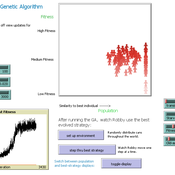
RobbyGA modified 2019
Timothy Gooding | Published Sunday, February 24, 2019This is a modification of the RobbyGA model by the Santa Fe Institute (see model Info tab for full information). The basic idea is that the GA has been changed to one where the agents have a set lifetime, anyone can reproduce with anyone, but where there is a user-set amount of ‘starvation’ that kills the agents that have a too low fitness.
Metaphoria 2019 eternal mutation
Timothy Gooding | Published Sunday, February 24, 2019This model is a modification of Metaphoria 2019, where the monetary system can be run with agents that do not die, but their characteristics are mutated as they are in the mortal population.
Metaphoria 2019 eternal fitness test
Timothy Gooding | Published Sunday, February 24, 2019This is a modification of Metaphoria 2019 so that the eternal population is subjected to all the evolutionary forces as the mortal population.
Displaying 10 of 396 results for "Tim Gooding" clear search