Our mission is to help computational modelers develop, document, and share their computational models in accordance with community standards and good open science and software engineering practices. Model authors can publish their model source code in the Computational Model Library with narrative documentation as well as metadata that supports open science and emerging norms that facilitate software citation, computational reproducibility / frictionless reuse, and interoperability. Model authors can also request private peer review of their computational models. Models that pass peer review receive a DOI once published.
All users of models published in the library must cite model authors when they use and benefit from their code.
Please check out our model publishing tutorial and feel free to contact us if you have any questions or concerns about publishing your model(s) in the Computational Model Library.
Displaying 3 of 3 results aging clear search
FishyGreensOS: Aquaponics & Multitrophic System Simulation
derrickatasu | Published Friday, September 25, 2026An agent-based model built in NetLogo that simulates a closed-loop recirculating aquaponics and integrated multitrophic aquaculture (IMTA) ecosystem, modeling the complex dynamics between aquatic species, vermaculture, and hydroponic plant beds. This model captures the operational mechanics of a complex, sustainable production network. It tracks nutrient flows, water recirculation pathways, biological growth stages, and environmental feedback penalties (such as nutrient toxicity or starvation) across multiple specialized tanks and grow beds. Model Architecture & HabitatsAquatic Subsystem: Duckweed Tank, Breeding Tank, Fry Tank, Fingerling Tank, Adult Tank, and a Holding Tank for harvested fish. Benthic & Waste Management: Crawdad Tank 1 & 2 for bottom-feeding and waste processing, alongside a Vermaculture node populated by composting worms. Hydroponic Subsystem: Five sequential Grow Beds and a recirculating loop feeding back into the system. Key Agent DynamicsWater Flow Visualization: Active links between tanks spawn animated droplet agents that visually simulate recirculating water dynamics across the network. Biological Growth & Aging: Fish and plants progress through age-based development thresholds governed by species-specific parameters. Feedback Loops:Toxicity Penalty: Excess nutrients (nutrient-per-day > 80) slow fish growth rates by 50%. Starvation Penalty: Insufficient nutrient levels (nutrient-per-day < 30) delay plant maturation by 50%. Interface Controlsfish-type Chooser: Selects the primary aquatic species (Tilapia, Channel Catfish, Trout, Goldfish), altering base growth thresholds. plant-type Chooser: Selects the cultivated crop (Lettuce, Basil, Tomatoes, Mint). nutrient-per-day Slider: Manages daily nutrient input to balance system load and avoid toxicity or starvation thresholds. Dashboard Plot: Real-time tracking of total-fish-harvested and total-plants-harvested.
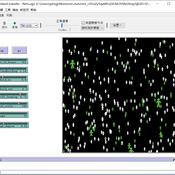
An Agent-based Model of Farmland Transfer (Version 1.0.0)
Hang Xiong Peng Jiang | Published Wednesday, August 11, 2021This is model that explores how a few farmers in a Chinese village, where all farmers are smallholders originally, reach optimal farming scale by transferring in farmland from other farmers in the context of urbanization and aging.
Change and Senescence
André Martins | Published Tuesday, November 10, 2020Agers and non-agers agent compete over a spatial landscape. When two agents occupy the same grid, who will survive is decided by a random draw where chances of survival are proportional to fitness. Agents have offspring each time step who are born at a distance b from the parent agent and the offpring inherits their genetic fitness plus a random term. Genetic fitness decreases with time, representing environmental change but effective non-inheritable fitness can increase as animals learn and get bigger.