STiMUS: A Stigmergic–Mutualistic Agent-Based Model of Teamwork on Shared Digital Artefacts (IMOI) 1.1.0
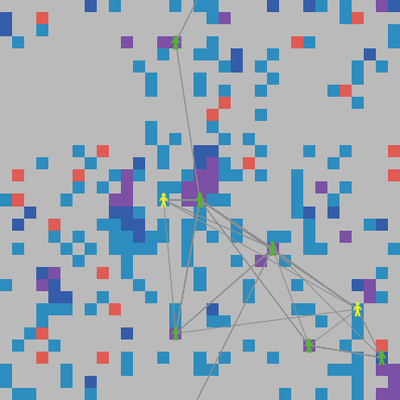
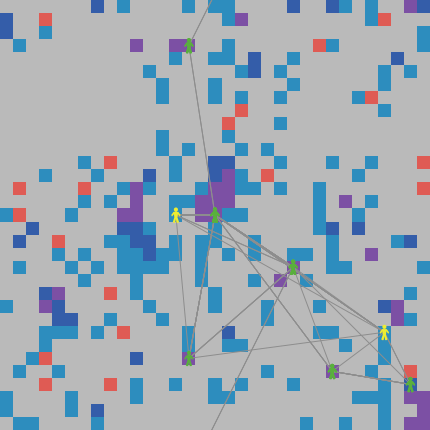
STiMUS (Stigmergic–Mutualistic IMOI Model) is an agent-based model of teamwork in socio-technical systems where contributors collaborate through shared digital artefacts — wiki pages, code files, issue tickets, project cards, Scratch projects — represented as patches in a NetLogo world. The model integrates two coordination mechanisms. Stigmergy is indirect coordination through traces left in a shared environment: each edit deposits a pheromone that diffuses to neighbouring patches and evaporates over time, so recent activity attracts further contributions. Mutualism is a reciprocal benefit loop in which valuable, well-maintained artefacts raise contributor motivation and shared understanding, while motivated contributors improve artefacts.
Contributors (turtles of the contributor breed) carry individual state: skill, motivation, shared-mental-model, specialty, benefit-gain, and an explicit-mode flag. At each tick every contributor selects a target artefact with an ant-colony-optimization-style rule weighing the artefact’s pheromone, incompleteness (1 - completeness), resource-value, and topic match between specialty and the artefact’s topic-tag; with probability p-explicit it instead takes the patch with the highest maintenance-need, modelling explicit task assignment. Each edit increases pheromone, quality, completeness and reuse-count, raises resource-value, lowers maintenance-need, and appends the editor to the artefact’s edit-authors list. When the previous last-editor-id differs from the current editor, the Edit Succession Ratio rises, the editor’s shared-mental-model grows, and a co-editing link is created — operationalising the idea that repeated cross-author succession on the same artefact builds shared understanding. Contributors’ motivation is updated from the benefit drawn from the visited artefact.
Each patch maintains a stigmergic layer (pheromone, quality, completeness, recentness, last-editor-id, edit-count, edit-authors) and a mutualistic layer (resource-value, reuse-count, maintenance-need, topic-tag), plus task flags (is-task?, task-complexity). Global monitors report the Edit Succession Ratio (ESR = cross-author-edits / total-edits, and an alternative esr-value = share of edited patches with more than one distinct author), mean-quality, mean-resource-value, a mutualism-index averaging contributor benefit and resource value, coediting-density (network density of the co-editing graph), active-pages-share, and task-completion-rate. The model logs every edit as a bipartite edge (tick, author_id, pageid, specialty, topic_tag, quality), exportable to CSV.
STiMUS instantiates the Input–Mediator–Output–Input (IMOI) team framework and is designed for empirical calibration against activity logs from MediaWiki, GitLab, Trello, and Scratch: parameters such as evaporation-rate map to a platform’s trace persistence, and p-explicit to the share of assigned versus self-selected work. Counterfactual sweeps over trace persistence, explicit-coordination share, and specialisation let researchers and instructors ask how environmental design shapes collaborative outcomes. The model is intended for education researchers, instructors, and modellers studying collaborative learning and digital pedagogy. Distinguishing human and AI contributors (bots, LLM assistants, CI/CD pipelines), a Gini coefficient of edits, and topic-based colouring are documented as planned extensions rather than features of the current release.
Release Notes
Initial public release. Core stigmergic–mutualistic model of teamwork on shared digital artefacts: ACO-style artefact selection, pheromone diffusion/evaporation, cross-author succession building shared mental model and co-editing network, bipartite edit logging with CSV export, and aggregate metrics (ESR, mutualism index, co-editing density, task completion rate, mean SMM).
Not yet implemented : AI contributor types and ai-share, show-topics? / count-ai-in-esr? switches, human-only vs all-agents ESR split, and Gini coefficient of edits.
All model inputs are set through the interface sliders listed above. There are no file-based inputs. Fixed internal parameters (pheromone exponents, gain factors, decay rates, etc.) are defined as to-report procedures in the Code tab and are not user-configurable without editing the code.