Boundary crossings as a minimal mechanism for global connectivity in structured landscapes (1.1.0)
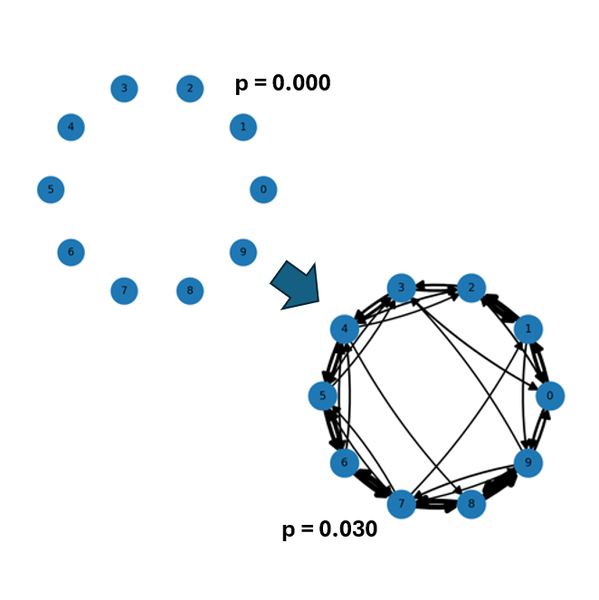
This repository contains the Python implementation of an agent-based model investigating how heterogeneous mobility and boundary-crossing dynamics generate large-scale connectivity in structured multi-attractor landscapes. A small fraction of higher-mobility agents explores the environment while the remaining agents stay locally constrained. The model compares pure random-walk exploration, interface-sensitive dynamics, novelty-biased exploration, and a flat-landscape control. The release includes the complete simulation framework, the experimental pipeline used in the associated paper, multi-K and population-scaling robustness analyses, network-snapshot and transition-slope analyses, and reproducibility documentation. Transition networks are analysed using graph density, connected components, and giant weakly connected components. The implementation is compatible with Python 3.11 and is released under the MIT License.
Release Notes
Version 1.1.1 associated with the revised manuscript “Boundary crossings as a minimal mechanism for global connectivity in structured landscapes”.
Changes relative to the published CoMSES release 1.0.0:
- expanded robustness analysis across K = 3, 5, 10 and 20 under native fixed-domain geometry;
- added constant-spacing, finite-time K = 50 and fixed-domain crowding diagnostics;
- added population-scaling, transition-slope and transition-network snapshot analyses;
- updated the main experimental pipeline, figures and run-level/aggregated outputs;
- added dedicated supplementary analysis scripts;
- updated README, requirements, citation metadata and changelog;
- archived the revised manuscript and supplementary material;
- separated the source-only code archive from simulation outputs for clearer reproducibility.
The corrective 1.1.1 packaging removes stale generated outputs from the source archive; it does not change the scientific model relative to GitHub release 1.1.0. Simulation outputs are archived separately in this CoMSES release.
Software archive: https://doi.org/10.5281/zenodo.23864812
Repository: https://github.com/meccanismocomplesso/boundary-connectivity-abm
Associated Publications
Nelli, F. Boundary crossings as a minimal mechanism for global connectivity in structured landscapes. arXiv:2606.07344. https://arxiv.org/abs/2606.07344
Nelli, F. Boundary crossings as a minimal mechanism for global connectivity in structured landscapes. SocArXiv preprint. https://osf.io/2tnfc/
https://doi.org/10.5281/zenodo.20145381
Boundary crossings as a minimal mechanism for global connectivity in structured landscapes 1.1.0
Submitted by
Fabio Nelli
Published Nov 05, 2026
Last modified Nov 05, 2026
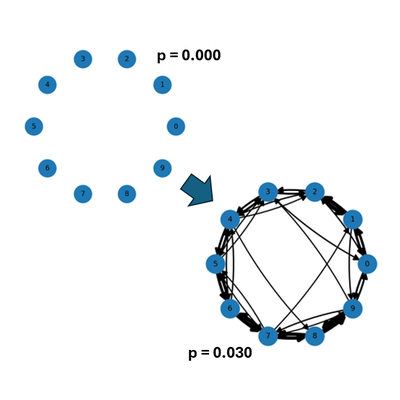
This repository contains the Python implementation of an agent-based model investigating how heterogeneous mobility and boundary-crossing dynamics generate large-scale connectivity in structured multi-attractor landscapes. A small fraction of higher-mobility agents explores the environment while the remaining agents stay locally constrained. The model compares pure random-walk exploration, interface-sensitive dynamics, novelty-biased exploration, and a flat-landscape control. The release includes the complete simulation framework, the experimental pipeline used in the associated paper, multi-K and population-scaling robustness analyses, network-snapshot and transition-slope analyses, and reproducibility documentation. Transition networks are analysed using graph density, connected components, and giant weakly connected components. The implementation is compatible with Python 3.11 and is released under the MIT License.
Release Notes
Version 1.1.1 associated with the revised manuscript “Boundary crossings as a minimal mechanism for global connectivity in structured landscapes”.
Changes relative to the published CoMSES release 1.0.0:
- expanded robustness analysis across K = 3, 5, 10 and 20 under native fixed-domain geometry;
- added constant-spacing, finite-time K = 50 and fixed-domain crowding diagnostics;
- added population-scaling, transition-slope and transition-network snapshot analyses;
- updated the main experimental pipeline, figures and run-level/aggregated outputs;
- added dedicated supplementary analysis scripts;
- updated README, requirements, citation metadata and changelog;
- archived the revised manuscript and supplementary material;
- separated the source-only code archive from simulation outputs for clearer reproducibility.
The corrective 1.1.1 packaging removes stale generated outputs from the source archive; it does not change the scientific model relative to GitHub release 1.1.0. Simulation outputs are archived separately in this CoMSES release.
Software archive: https://doi.org/10.5281/zenodo.23864812
Repository: https://github.com/meccanismocomplesso/boundary-connectivity-abm