
Mario Javier Rodriguez Ureta
AffiliationsBirkbeck, University of London
Professional homepagehttps://www.bbk.ac.uk/our-staff/profile/9439232/mario-javier-rodriguez-ureta
ORCID more infohttps://orcid.org/0009-0008-3393-6565
GitHub more info
Mario Ureta holds a BSc in Economics from Birkbeck, University of London, a Graduate Diploma in Data Science from the London School of Economics, and an MSc in Data Science and Analytics from Brunel University London. He is currently a PhD student in Computing Science at Birkbeck, University of London. His research focuses on the economic study of individual preferences and decision-making, and on the use of agent-based models as a bridge between economic theory and computational experimentation. Through economic simulation, his work examines how heterogeneous preferences, social interaction, and firm behaviour jointly shape aggregate market outcomes, including non-linear dynamics and tipping points.
Research Interests
My research interests centre on the study of individual preferences in economics and on understanding how preferences evolve through interaction, learning, and social context. I am particularly interested in how seemingly weak or latent preferences—such as attitudes toward environmental attributes, prices, or social norms—can become amplified through feedback mechanisms and generate non-linear aggregate outcomes. A core methodological focus of my work is the use of agent-based modelling and economic simulation as a bridge between economic theory and experimentation. By treating agent-based models as computational laboratories, I explore how heterogeneous preferences, habit formation, peer influence, and firm behaviour interact dynamically, allowing theoretical mechanisms to be tested, stress-tested, and compared under controlled but flexible conditions that are difficult to achieve using purely analytical or empirical approaches.
Peer reviewed Green Consumption Tipping Point
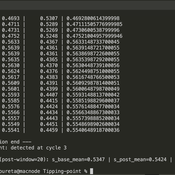
Mario | Published Thursday, February 26, 2026This model is a minimal agent-based model (ABM) of green consumption and market tipping dynamics in a stylised two-firm economy. It is designed as an existence proof to illustrate how weak individual preferences, when combined with habit formation, social influence, and firm price adaptation, can generate non-linear transitions (tipping points) in market outcomes.
The economy consists of:
1) Two firms, each supplying a differentiated consumption bundle that differs in its fixed green share (one relatively greener, one less green).
2) Many households, each consuming a unit mass per period and allocating consumption between the two firms.
…
Under development.