Our mission is to help computational modelers develop, document, and share their computational models in accordance with community standards and good open science and software engineering practices. Model authors can publish their model source code in the Computational Model Library with narrative documentation as well as metadata that supports open science and emerging norms that facilitate software citation, computational reproducibility / frictionless reuse, and interoperability. Model authors can also request private peer review of their computational models. Models that pass peer review receive a DOI once published.
All users of models published in the library must cite model authors when they use and benefit from their code.
Please check out our model publishing tutorial and feel free to contact us if you have any questions or concerns about publishing your model(s) in the Computational Model Library.
Displaying 1 of 1 results stochastic processes clear search
Peer reviewed Boundary crossings as a minimal mechanism for global connectivity in structured landscapes
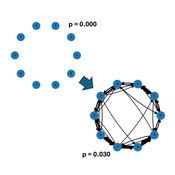
Fabio Nelli | Published Sunday, May 17, 2026 | Last modified Thursday, November 05, 2026This repository contains the Python implementation of an agent-based model investigating how heterogeneous mobility and boundary-crossing dynamics generate large-scale connectivity in structured multi-attractor landscapes. A small fraction of higher-mobility agents explores the environment while the remaining agents stay locally constrained. The model compares pure random-walk exploration, interface-sensitive dynamics, novelty-biased exploration, and a flat-landscape control. The release includes the complete simulation framework, the experimental pipeline used in the associated paper, multi-K and population-scaling robustness analyses, network-snapshot and transition-slope analyses, and reproducibility documentation. Transition networks are analysed using graph density, connected components, and giant weakly connected components. The implementation is compatible with Python 3.11 and is released under the MIT License.