Fire-WCISG (1.0.0)
An integrated wildfire and urban growth model for informal settlements.
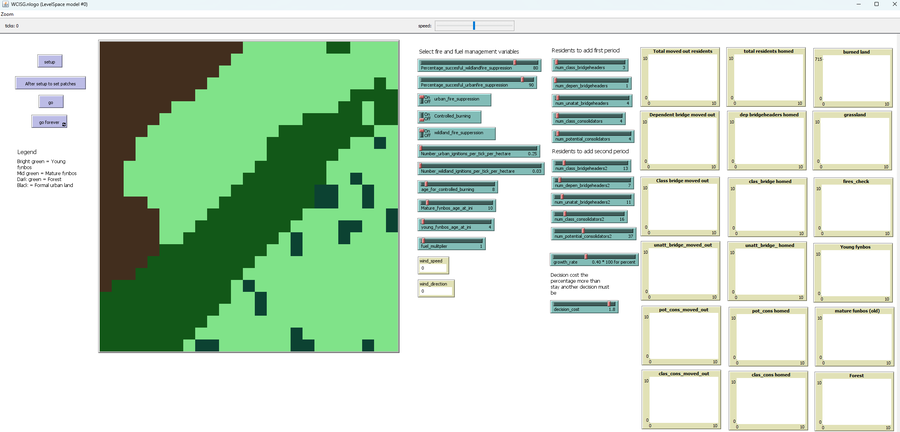
Fire-WCISG is developed to test the impact of different fire management strategies on the number and type of residents staying in an informal settlement, and the fire-dependent fynbos vegetation that it is next to.
The model uses a hybrid protection motivation theory, place attachment and Turner’s informal residents as described by Christ et al. (2023) (10.1016/j.habitatint.2023.102815), for the agents decision making. Wildland vegetation is based on published understanding of fynbos ecology.
The model by Rohan Fisher and colleagues is used for the fire modelling.
This model uses LevelSpace to communicate between two models the “fire” and the “WCISG” models to create Fire-WCISG.
Release Notes
Initial release
This version of the model is used in the paper Exploring Fire Management Strategies at the Wildland-Urban Interface with an Agent-Based Model Framework which is available at: https://doi.org/10.1007/s00267-026-02561-7.
Related models
The fire model used in this model was developed and described in the paper by Fisher et al. (2021). The paper can be found at: https://doi.org/10.3390/fire4030046
Getting started
Install NetLogo from the Netlogo website
Download the model for review. Extract the downloaded model.
Copy the contents of the data folder into the code folder, so that the ASCII, output and Agent_data.csv files are in the same folder as the models.
Open the Fire-WCISG model (.nlogo file), you can now set the settings required and press “setup” and “go” to test the model.
Once the model has run you need to copy the output to a folder for analysis and copy the blank_for_output folders back into the output folder for a second run.
For convenience of review, in the behaviourspace tab the settings used in the model is available.
Associated Publications
The model is used in the paper Exploring Fire Management Strategies at the Wildland-Urban Interface with an Agent-Based Model Framework which is available at: https://doi.org/10.1007/s00267-026-02561-7.
Fire-WCISG 1.0.0
Submitted by
Sven Christ
Published Jul 25, 2026
Last modified Jul 25, 2026
An integrated wildfire and urban growth model for informal settlements.
Fire-WCISG is developed to test the impact of different fire management strategies on the number and type of residents staying in an informal settlement, and the fire-dependent fynbos vegetation that it is next to.
The model uses a hybrid protection motivation theory, place attachment and Turner’s informal residents as described by Christ et al. (2023) (10.1016/j.habitatint.2023.102815), for the agents decision making. Wildland vegetation is based on published understanding of fynbos ecology.
The model by Rohan Fisher and colleagues is used for the fire modelling.
This model uses LevelSpace to communicate between two models the “fire” and the “WCISG” models to create Fire-WCISG.
Release Notes
Initial release
This version of the model is used in the paper Exploring Fire Management Strategies at the Wildland-Urban Interface with an Agent-Based Model Framework which is available at: https://doi.org/10.1007/s00267-026-02561-7.
Related models
The fire model used in this model was developed and described in the paper by Fisher et al. (2021). The paper can be found at: https://doi.org/10.3390/fire4030046
Getting started
Install NetLogo from the Netlogo website
Download the model for review. Extract the downloaded model.
Copy the contents of the data folder into the code folder, so that the ASCII, output and Agent_data.csv files are in the same folder as the models.
Open the Fire-WCISG model (.nlogo file), you can now set the settings required and press “setup” and “go” to test the model.
Once the model has run you need to copy the output to a folder for analysis and copy the blank_for_output folders back into the output folder for a second run.
For convenience of review, in the behaviourspace tab the settings used in the model is available.