The Andean Resource Management Model (ARMM) (1.0.0)
ARMM is a theoretical agent-based model that formalizes Murra’s Theory of Verticality (Murra, 1972) to explore how multi-zonal resource management systems emerge in mountain landscapes. The model identifies the social, political, and economic mechanisms that enable vertical complementarity across ecological gradients.
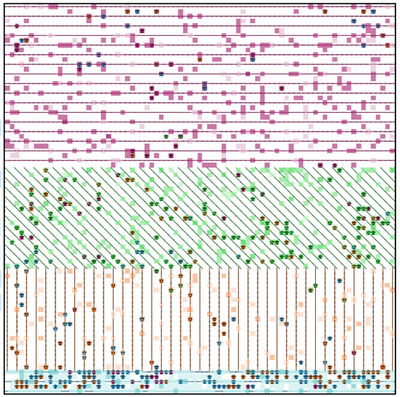
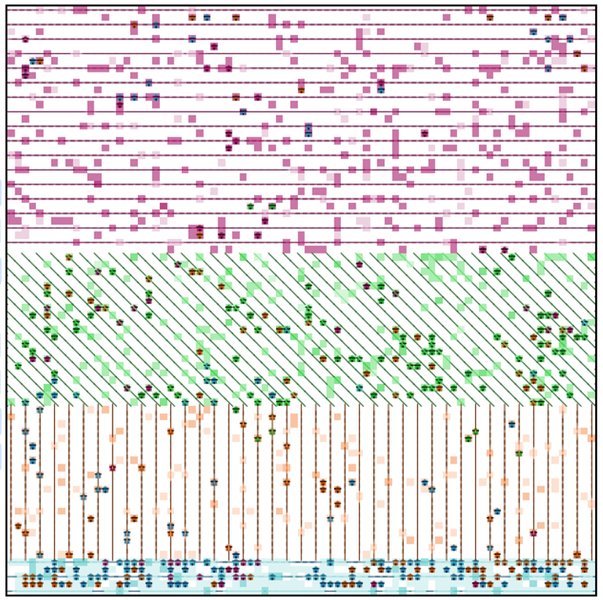
Built in NetLogo, ARMM employs an abstract 111×111 grid divided into four Andean ecological zones (Altiplano, Highland, Lowland, Coast), each containing up to 18 resource types distributed according to ecological suitability. To test general theoretical principles rather than replicate specific geography, resource locations are randomized at each model initialization.
Settlement agents pursue one of two economic strategies: diversification (seeking resource variety, maximum 2 units per type) or accumulation (maximising total quantity, maximum 30 units). Agents move between adjacent zones through hierarchical decision-making, first attempting peaceful interactions—coexistence (governed by tolerance) and trading (governed by cooperation)—before resorting to conflict (theft or takeover, governed by belligerence).
The model demonstrates that vertical complementarity can emerge through fundamentally different mechanisms: either through autonomous mobility under political decentralization or through state-coordinated redistribution under centralization. Sensitivity analysis reveals that belligerence and economic strategy explain approximately 25% of outcome variance, confirming that structural inequalities between zones result from political-economic organization rather than environmental constraints alone.
As a preliminary theoretical model, ARMM intentionally maintains simplicity to isolate core mechanisms and generate testable hypotheses. This foundational framework will guide future empirically-calibrated versions that incorporate specific archaeological settlement data and geographic features from the Carangas region (Bolivia-Chile border), enabling direct comparison between theoretical predictions and observed historical patterns.
Release Notes
Overview
This is the initial public release of the Andean Resource Management Model (ARMM), a theoretical agent-based model exploring vertical complementarity systems in mountain landscapes. This version corresponds to the model described in Palacios et al. (submitted) “Modelling Vertical Complementarity: The Andean Resource Management Model (ARMM)”.
Model Purpose
ARMM formalizes Murra’s Theory of Verticality to identify social, political, and economic mechanisms enabling multi-zonal resource management across ecological gradients. The model serves as a theoretical framework for hypothesis generation, intentionally maintaining abstraction to isolate fundamental mechanisms before future empirical calibration.
Associated Publications
Murra, J. V. (1972). El control vertical de un máximo de pisos ecológicos en la economía de las sociedades andinas. In Visita de la Provincia de León de Huánuco en 1562, Iñigo Ortiz de Zúñiga, visitador (Vol. 2, pp. 429–476). Universidad Nacional Hermilio Valdizán.
The Andean Resource Management Model (ARMM) 1.0.0
Submitted byOlga PalaciosPublished Jan 20, 2026
Last modified Jan 20, 2026
ARMM is a theoretical agent-based model that formalizes Murra’s Theory of Verticality (Murra, 1972) to explore how multi-zonal resource management systems emerge in mountain landscapes. The model identifies the social, political, and economic mechanisms that enable vertical complementarity across ecological gradients.
Built in NetLogo, ARMM employs an abstract 111×111 grid divided into four Andean ecological zones (Altiplano, Highland, Lowland, Coast), each containing up to 18 resource types distributed according to ecological suitability. To test general theoretical principles rather than replicate specific geography, resource locations are randomized at each model initialization.
Settlement agents pursue one of two economic strategies: diversification (seeking resource variety, maximum 2 units per type) or accumulation (maximising total quantity, maximum 30 units). Agents move between adjacent zones through hierarchical decision-making, first attempting peaceful interactions—coexistence (governed by tolerance) and trading (governed by cooperation)—before resorting to conflict (theft or takeover, governed by belligerence).
The model demonstrates that vertical complementarity can emerge through fundamentally different mechanisms: either through autonomous mobility under political decentralization or through state-coordinated redistribution under centralization. Sensitivity analysis reveals that belligerence and economic strategy explain approximately 25% of outcome variance, confirming that structural inequalities between zones result from political-economic organization rather than environmental constraints alone.
As a preliminary theoretical model, ARMM intentionally maintains simplicity to isolate core mechanisms and generate testable hypotheses. This foundational framework will guide future empirically-calibrated versions that incorporate specific archaeological settlement data and geographic features from the Carangas region (Bolivia-Chile border), enabling direct comparison between theoretical predictions and observed historical patterns.
Release Notes
Overview
This is the initial public release of the Andean Resource Management Model (ARMM), a theoretical agent-based model exploring vertical complementarity systems in mountain landscapes. This version corresponds to the model described in Palacios et al. (submitted) “Modelling Vertical Complementarity: The Andean Resource Management Model (ARMM)”.
Model Purpose
ARMM formalizes Murra’s Theory of Verticality to identify social, political, and economic mechanisms enabling multi-zonal resource management across ecological gradients. The model serves as a theoretical framework for hypothesis generation, intentionally maintaining abstraction to isolate fundamental mechanisms before future empirical calibration.
Cite this Model
Olga Palacios (2026, January 20). “The Andean Resource Management Model (ARMM)” (Version 1.0.0). CoMSES Computational Model Library. Retrieved from: https://doi.org/10.25937/9rs5-va63
Associated Publication(s)
Murra, J. V. (1972). El control vertical de un máximo de pisos ecológicos en la economía de las sociedades andinas. In Visita de la Provincia de León de Huánuco en 1562, Iñigo Ortiz de Zúñiga, visitador (Vol. 2, pp. 429–476). Universidad Nacional Hermilio Valdizán.
Create an Open Code Badge that links to this model more info
This website uses cookies and Google Analytics to help us track user engagement and improve our site. If
you'd like to know more information about what data we collect and why, please see
our data privacy policy. If you continue to use this site, you consent to
our use of cookies.