Our mission is to help computational modelers develop, document, and share their computational models in accordance with community standards and good open science and software engineering practices. Model authors can publish their model source code in the Computational Model Library with narrative documentation as well as metadata that supports open science and emerging norms that facilitate software citation, computational reproducibility / frictionless reuse, and interoperability. Model authors can also request private peer review of their computational models. Models that pass peer review receive a DOI once published.
All users of models published in the library must cite model authors when they use and benefit from their code.
Please check out our model publishing tutorial and feel free to contact us if you have any questions or concerns about publishing your model(s) in the Computational Model Library.
Displaying 1 of 1 results causal attribution clear search
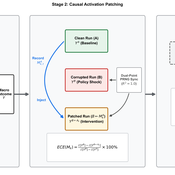
ACD-ABM: mechanism circuit tracing demonstrated on three agent-based simulators (network SIR, interbank contagion, NearshoreABM_XAI)
Alejandro Platas López | Published Wednesday, November 25, 2026Three stochastic simulators and the code that traces causal mechanisms in them. (1) Network SIR: a susceptible-infected-recovered process on a Barabási-Albert network of 100 agents. (2) Interbank contagion: 100 banks in which distress spreads through DebtRank dynamics and through fire sales of a common illiquid asset, with two policy instruments, emergency liquidity assistance and a market-maker of last resort. (3) NearshoreABM_XAI: the NearshoreABM model of anchor and supplier firms in the 32 Mexican states, instrumented so that the outputs of its credit, matching and infrastructure mechanisms can be recorded and injected.
The three are analyzed with ACD-ABM, a gradient-free method that attributes the effect of a policy on an aggregate outcome to the model’s mechanisms and to the simulation steps at which they act. It records the output of each mechanism in a baseline run, injects it into a policy run whose random number generator is synchronized with the baseline, and measures the share of the policy effect that the patch undoes (Expected Causal Effect), with paired bootstrap intervals, a coverage check of the mechanism partition and a rule that declines attribution when the policy effect cannot be distinguished from zero. The method is implemented in a simulator-independent Julia module.
All scripts, input data and reference outputs needed to reproduce the tables and figures of the associated article are included.