Our mission is to help computational modelers develop, document, and share their computational models in accordance with community standards and good open science and software engineering practices. Model authors can publish their model source code in the Computational Model Library with narrative documentation as well as metadata that supports open science and emerging norms that facilitate software citation, computational reproducibility / frictionless reuse, and interoperability. Model authors can also request private peer review of their computational models. Models that pass peer review receive a DOI once published.
All users of models published in the library must cite model authors when they use and benefit from their code.
Please check out our model publishing tutorial and feel free to contact us if you have any questions or concerns about publishing your model(s) in the Computational Model Library.
Displaying 10 of 69 results for "Michael Roos" clear search
Collective Decision Making for Ecological Restoration
Cristy Watkins Dean Massey Jeremy Brooks Kristen Ross Moira Zellner | Published Friday, December 30, 2011 | Last modified Friday, November 21, 2014We present an agent-based model that maps out and simulates the processes by which individuals within ecological restoration organizations communicate and collectively make restoration decisions.
Waste separation in small-world networks
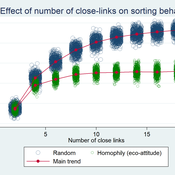
František Kalvas Michaela Kudrnáčová | Published Monday, September 30, 2019The model answers the question how homophily and number of close-links in small-world network influences behavior of consumats. The results show that the more close-links the more probable the consumat follows the major behavior, but homophilly blocks the major behavior and supports survival of the minor behavior.
Neolithic Spread Model Version 1.0
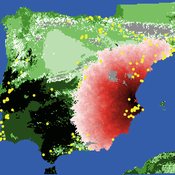
Sean Bergin Michael Barton Salvador Pardo Gordo Joan Bernabeu Auban | Published Thursday, December 11, 2014 | Last modified Monday, December 31, 2018This model simulates different spread hypotheses proposed for the introduction of agriculture on the Iberian peninsula. We include three dispersal types: neighborhood, leapfrog, and ideal despotic distribution (IDD).
Managing networked landscapes: conservation in fragmented, regionally connected world
Jacopo A. Baggio Michael Schoon Sechindra Vallury | Published Monday, December 09, 2019Exploring how learning and social-ecological networks influence management choice set and their ability to increase the likelihood of species coexistence (i.e. biodiversity) on a fragmented landscape controlled by different managers.
SimDrink: An agent-based NetLogo model of young, heavy drinkers for conducting alcohol policy experiments
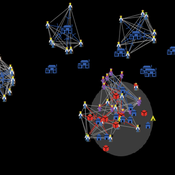
Nick Scott Michael Livingston Aaron Hart James Wilson David Moore Paul Dietze | Published Friday, September 25, 2015 | Last modified Thursday, October 15, 2015A proof-of-concept agent-based model ‘SimDrink’, which simulates a population of 18-25 year old heavy alcohol drinkers on a night out in Melbourne to provide a means for conducting policy experiments to inform policy decisions.
Simulating Components of the Reinforcing Spirals Model and Spiral of Silence
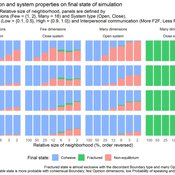
František Kalvas Ashley Sanders-Jackson Michael D. Slater | Published Friday, November 05, 2021Communication processes occur in complex dynamic systems impacted by person attitudes and beliefs, environmental affordances, interpersonal interactions and other variables that all change over time. Many of the current approaches utilized by Communication researchers are unable to consider the full complexity of communication systems or the over time nature of our data. We apply agent-based modeling to the Reinforcing Spirals Model and the Spiral of Silence to better elucidate the complex and dynamic nature of this process. Our preliminary results illustrate how environmental affordances (i.e. social media), closeness of the system and probability of outspokenness may impact how attitudes change over time. Additional analyses are also proposed.
Collective Decision Making for Ecological Restoration version 2.0
Moira Zellner Dean Massey Cristy Watkins Lynne M Westphal Kristen Ross Jeremy Brooks | Published Wednesday, November 19, 2014CoDMER v. 2.0 was parameterized with ethnographic data from organizations dealing with prescribed fire and seeding native plants, to advance theory on how collective decisions emerge in ecological restoration.
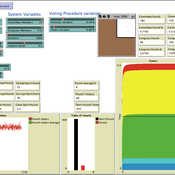
Sunshine or Shield?: Secret Voting Procedures and Legislative Accountability
Michele Buttò Carlos Pereira Matthew Taylor | Published Tuesday, June 24, 2014 | Last modified Monday, April 08, 2019An agent-based model is used to simulate legislators’ behavior under secret voting rules, as influenced by the power of the accused politician, the composition of the voting body, and the publicity of the accusations.
The Pampas Model: An agent-based model of agricultural systems in the Argentinean Pampas
Federico Bert Guillermo P Podestá Santiago L Rovere Michael North Charles Macal | Published Tuesday, July 16, 2013 | Last modified Tuesday, February 17, 2015The Pampas Model is an Agent-Based Model intended to explore the dynamics of structural and land use changes in agricultural systems of the Argentine Pampas in response to climatic, technological economic, and political drivers.
Agent-Based Simulation of Operational and Fare Integration in Multi-Operator Bus Networks: Institutional Trade-offs and Robustness Analysis
Lorenzo Ros-McDonnell María Victoria de-la-Fuente-Aragon Salvador Martinez-Artero-Martinez Khaoula El Bied | Published Tuesday, November 03, 2026This study separates operational interoperability, fare integration and revenue-sharing governance in a stylised multi-operator bus network. An agent-based model implemented in NetLogo 7.0.3 represents passengers, buses and stations across 14 stations, nine routes and three operators. A 2 × 2 institutional design is complemented by financial clearing comparisons and 43,200 robustness runs: behavioural sensitivity (E1), a 243-configuration operational factorial (E2), and targeted joint behavioural–operational stress testing (E3). The audited experiment records show favourable interoperability effects on waiting, total travel time, transfers and realised generalised cost in all 1,944 E2 and 768 E3 configuration-level primary comparisons. Fare integration substantially reduces passenger expenditure but produces an aggregate deficit under the assumed accounting coefficients. Revenue-sharing rules redistribute operator-level outcomes without changing aggregate profit or passenger trajectories by construction. The model is intended to identify mechanisms and test conditional robustness, not predict city-specific policy effects. The paper contributes an explicit separation of access, pricing and settlement mechanisms coupled with reproducible factorial and stress-test comparisons.
Displaying 10 of 69 results for "Michael Roos" clear search