Our mission is to help computational modelers develop, document, and share their computational models in accordance with community standards and good open science and software engineering practices. Model authors can publish their model source code in the Computational Model Library with narrative documentation as well as metadata that supports open science and emerging norms that facilitate software citation, computational reproducibility / frictionless reuse, and interoperability. Model authors can also request private peer review of their computational models. Models that pass peer review receive a DOI once published.
All users of models published in the library must cite model authors when they use and benefit from their code.
Please check out our model publishing tutorial and feel free to contact us if you have any questions or concerns about publishing your model(s) in the Computational Model Library.
Displaying 10 of 183 results for "Bennett Holman" clear search
Artificial Anasazi: Baseline Fixes, Dynamic Soil and Plot Crowding
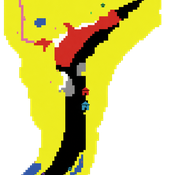
Thomas Tuoti | Published Sunday, October 04, 2026Artificial Anasazi is an agent-based model of farming households in the Long House Valley, Arizona, from 800 to 1350 CE. Each household chooses where to farm and settle based on expected harvest, water sources and stored maize, and simulated household counts are compared with the archaeological record.
This release adapts the NetLogo Models Library version (Stonedahl & Wilensky 2010) of Janssen’s (2009) NetLogo replication of the original Ascape model (Dean et al. 2000; Axtell et al. 2002). It contains four configurations in one NetLogo 7.0.4 file, selected with two switches:
- Both switches off: the baseline, which is the Models Library model with small fixes that make it work as intended (the arable-uplands zone name, the setup base yield, the initial household count, one-tick-lag capacity reporting, and seed control with observation-only instruments).
soil-on?: dynamic soil quality that depletes under cultivation and regrows, following Janssen (2010, eq. 4).
…
Team Structure and Task Performance
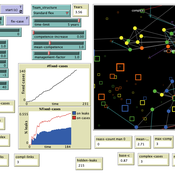
Davide Secchi Martin Neumann | Published Monday, August 05, 2024This model was designed to study resilience in organizations. Inspired by ethnographic work, it follows the simple goal to understand whether team structure affects the way in which tasks are performed. In so doing, it compares the ‘hybrid’ data-inspired structure with three more traditional structures (i.e. hierarchy, flexible/relaxed hierarchy, and anarchy/disorganization).
Flocking 3D Market: Social Proof and Congestion in a Multi-Floor Market
mmjqaq | Published Saturday, November 14, 2026A NetLogo 3D 7.0 model of a market with several floors. Buyers walk, keep their distance from one another, choose among the stalls they can see and change floors. Social proof acts on where buyers go (attraction) and on whether they buy (conversion), and crowding lowers the chance of a purchase. The model tests whether social proof is sufficient to congest such a market and separates the roles of influence, layout and local density. The archive contains the model with every BehaviorSpace experiment of the companion paper, all simulation outputs, the pre-analysis plan, an ODD+D description and the Python code that reproduces every reported number, table and figure.
Peer reviewed Collective Problem-Solving Capacity, Trust, and O-Ring Team Productivity
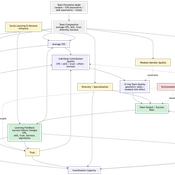
Taseer Salahuddin Hasan Vergil Muhammad Abdullah Yasser | Published Saturday, August 08, 2026This is a NetLogo 7.0.1 agent-based model of interdependent team productivity under O-ring production logic. The model asks when collective problem-solving capacity (CPS) improves team output and when its effect is constrained by trust, burnout, specialization diversity, weak-link quality, and team-formation rules. Agents are heterogeneous in skill, CPS, trust, burnout, effort, learning rate, openness, specialization, adaptability, and aspiration. Each tick forms temporary teams, computes individual contribution quality, combines contributions through a geometric O-ring production function with an explicit weakest-link term, records output and success, and updates agents through feedback, learning, trust change, burnout, recovery, and turnover. The paper follows the ODD protocol, reports exact implementation equations, and analyzes six BehaviorSpace experiments with 50 stochastic repetitions per condition. Scenario results show that CPS is beneficial but not sufficient: productivity is highest when CPS is combined with trust, low burnout, effective coordination, and a reliable weakest-link floor. Diversity yields only modest gains at low CPS but larger gains when CPS is high. Formation-mode results are especially informative because mixed CPS-skill formation maximizes total output, whereas random formation has the highest binary success rate, showing that output magnitude and threshold success can diverge. The study contributes a transparent computational mechanism linking collective intelligence with O-ring production and identifies boundary conditions under which high-CPS teams can still be limited by weak links and interdependence.
Hominin ecodynamics v.2
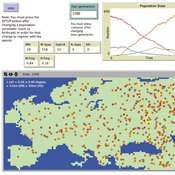
C Michael Barton | Published Monday, September 19, 2011 | Last modified Friday, March 28, 2014Simulates biobehavioral interactions between 2 populations of hominins.
BENCHv.2 model
Leila Niamir | Published Sunday, April 28, 2019The BENCH agent-based model is designed and developed to study shifts in residential energy use and corresponding emissions driven by behavioral changes among heterogeneous individuals.
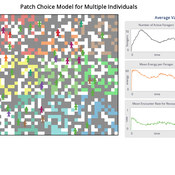
Peer reviewed An agent-based implementation of the optimal foraging patch choice model for multiple individuals
C Michael Barton | Published Sunday, September 20, 2026patch_choice_enhanced.nlogox is an agent-based model (ABM) implementing the patch choice model from optimal foraging theory (OFT) in a multi-agent simulation environment. It extends the classical single-forager, equation-based Marginal Value Theorem (MVT) formulation to support multiple competing foragers, demographic processes, bounded memory, and stochastic resource dynamics on a spatially heterogeneous landscape.
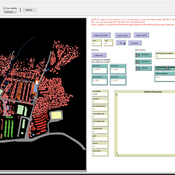
AIforGoodSimulator - Modeling Covid-19 Spread and Potential Interventions in Refugee Camps
Shyaam Ramkumar Woi Sok Oh | Published Thursday, March 18, 2021The Netlogo model is a conceptualization of the Moria refugee camp, capturing the household demographics of refugees in the camp, a theoretical friendship network based on values, and an abstraction of their daily activities. The model then simulates how Covid-19 could spread through the camp if one refugee is exposed to the virus, utilizing transmission probabilities and the stages of disease progression of Covid-19 from susceptible to exposed to asymptomatic / symptomatic to mild / severe to recovered from literature. The model also incorporates various interventions - PPE, lockdown, isolation of symptomatic refugees - to analyze how they could mitigate the spread of the virus through the camp.
FEARLUS-SPOMM
Gary Polhill Nick Gotts Alistair Law Luis Izquierdio Alessandro Gimona Lee-Ann Sutherland Dawn Parker | Published Friday, March 25, 2016This is a coupled conceptual model of agricultural land decision-making and incentivisation and species metacommunities.
Fertility Tradeoffs
Kristin Crouse | Published Tuesday, November 05, 2019 | Last modified Wednesday, March 25, 2026Fertility Tradeoffs is an agent-based model that examines how parental investment strategies evolve under density-dependent conditions. Humans occupy territories that compete for limited space, and reproduction requires both resources and available territory. Individuals inherit investment strategies that determine how much time and resources are required to raise a child, creating a tradeoff between number of children and investment per child. As space fills, territory costs increase and population growth slows, producing logistic-like dynamics. By manipulating child mortality and resource availability, the model demonstrates how environmental conditions shape both population outcomes and the evolution of reproductive strategies.
Displaying 10 of 183 results for "Bennett Holman" clear search